Buying Guides
Rigid Box vs Folding Carton: How to Choose
Compare rigid boxes and folding cartons: how each one is built, what it protects, what it costs to ship, and which one fits your product, budget, and unboxing experience.
Introduction
If you are choosing packaging for a product, the first structural decision is usually this one: a rigid box or a folding carton? They look similar on a shelf, but they are built differently, protect differently, ship differently, and cost differently.
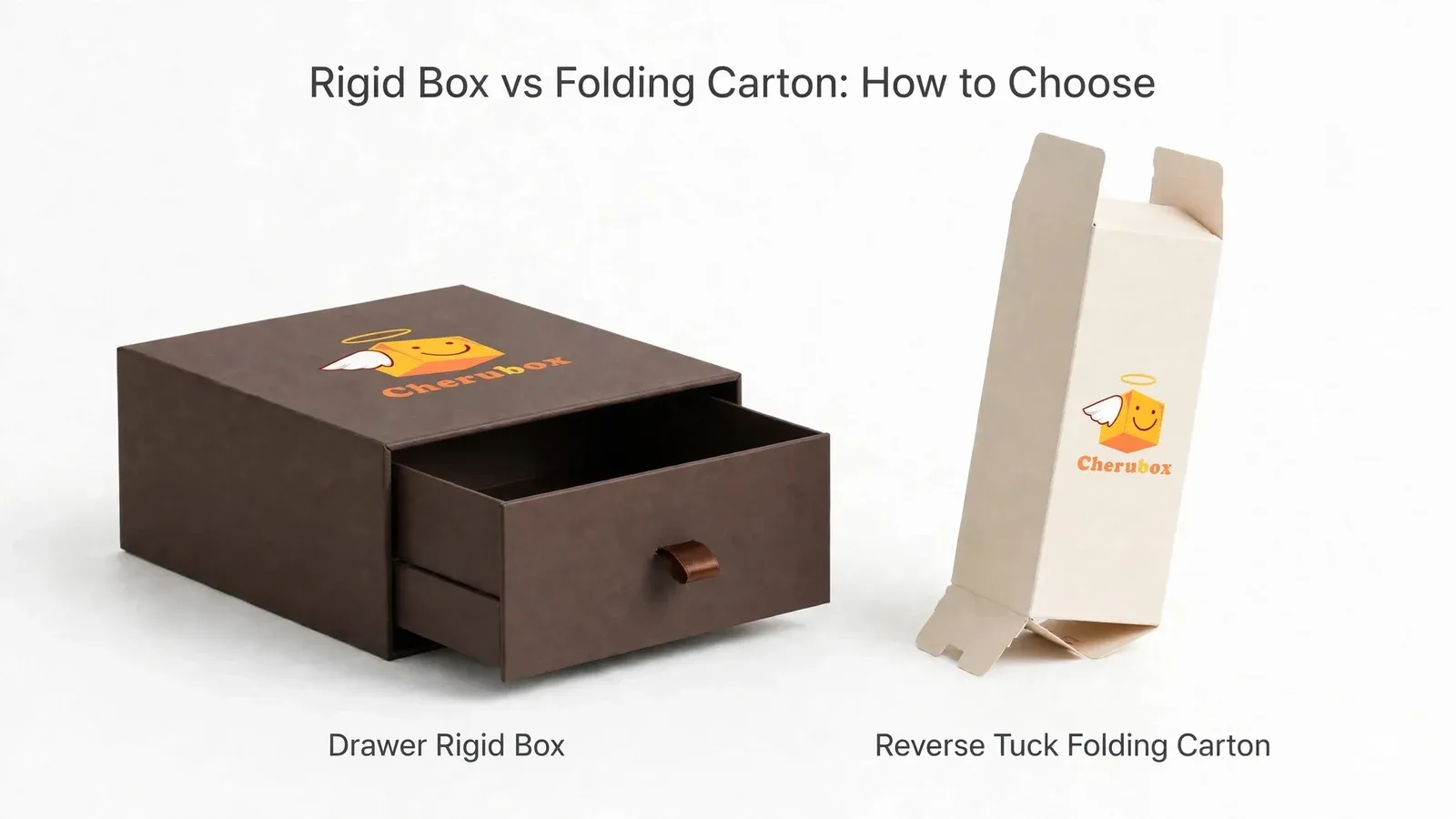
A rigid box is made from thick paperboard — greyboard wrapped in printed or specialty paper — and arrives as a finished, set-up box. A folding carton is made from thinner paperboard, such as SBS, C1S, or kraft, folded and glued into shape, and is normally supplied flat.
So which one should you choose? For a lightweight retail product where cost and flat-pack shipping matter most, a folding carton is the practical default. For a premium product where the box itself is part of the value — a gift set, a launch, a keepsake — a rigid box is the safer choice. The deciding factors are your product's weight, how the box will be used, and what the unboxing should feel like — not the box alone.
After reading this article, you will know how each structure is built, where each one works and where it fails, and what to send a supplier so they can recommend the right one for your product.
Why This Choice Matters
The box type sets the first impression and the cost structure at the same time. A folding carton is folded from a flat sheet, so it ships flat, stores flat, and is assembled when it is packed. A rigid box is already a box when it arrives, so it takes up more shipping and storage volume — unless it is a collapsible rigid box, which folds flat and is assembled before use.
It also sets what the customer feels. A rigid box holds its shape when it is picked up, opened, and kept. A folding carton is lighter and more flexible, which is fine for a product that is taken out and the box recycled, but less suited to a box the customer is meant to keep.
This matters most when the product sits between the two: a serum bottle, for example, can go in either. On Cherubox, the same serum bottle has two real options — a Custom Straight Tuck End Box, a folding carton for individual bottles, and a Custom Magnetic Closure Serum Box, a hinged rigid box for a single bottle or a skincare set. The carton is the practical retail option; the rigid box is the premium presentation option. The product is the same — the decision is about positioning, not about the bottle.
Choose the structure for how the product will be sold, shipped, and kept — not only for how the box looks in a photograph.
Key Factors to Compare
How Each One Is Built
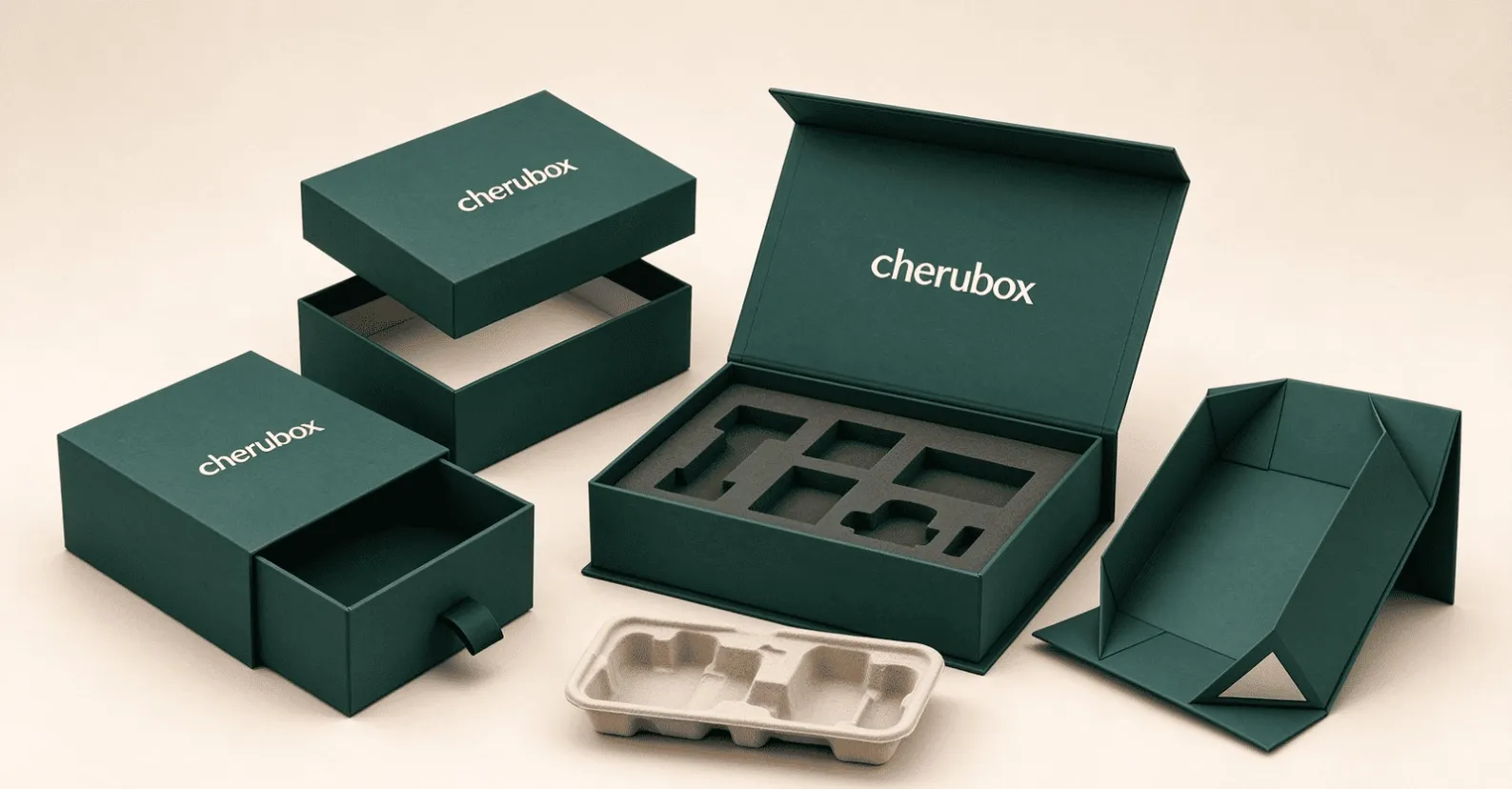
A rigid box starts with thick paperboard. On a Custom Lift-Off Lid Rigid Box, the structure is a separate lid and a sturdy base, made from greyboard wrapped in printed or specialty paper. On the magnetic serum box, it is a hinged rigid box with a magnetic closure, also paper-wrapped greyboard. The board is thick enough that the box keeps its shape on its own, with no product inside.
A folding carton starts with thinner paperboard. A straight tuck end box has top and bottom tuck flaps that fold in the same direction, both attached to the same main panel. The carton is die-cut, folded, and glued, and is supplied flat. It only becomes a box when it is folded up and the flaps are tucked in.
The practical difference is stiffness. A rigid box is a structure; a folding carton is a folded sheet. That is why a rigid box can stand on its own as a gift or display box, while a folding carton depends on the product inside it and on being packed correctly to hold its shape.
What Each One Protects
A rigid box protects by being rigid. Thick paperboard resists crushing and keeps its corners, and a fitted insert — paperboard, moulded pulp, EVA foam, or a thermoformed tray — can hold a glass bottle still inside it. That is why rigid boxes are used for glass dropper bottles, jewellery, and gift sets, where the product is fragile or the presentation matters.
A folding carton protects less, and its limits are stated on the product page itself. Straight tuck end boxes are generally best suited for lightweight to moderately weighted products, depending on the paperboard grade, box dimensions, and closure design. Because the bottom uses a tuck-in closure rather than a glued or automatic locking bottom, it may not be the best choice for heavier products or for applications that need additional bottom security. For heavier products, Cherubox recommends considering an auto-lock bottom carton instead.
So the weight question comes first: a light tube, a single serum bottle, or a sachet set is a folding-carton product. A heavy glass jar, a multi-bottle set, or a product that must survive handling without the box flexing is a rigid-box product. When in doubt, say the product's weight and let the supplier check it against the structure — and test the fit on a sample with the real product inside.
Cost, Shipping, and Storage
A folding carton is the lower-cost structure of the two. Cherubox describes the straight tuck end structure as a cost-effective choice for many retail projects, and the cartons are supplied flat, which reduces shipping and storage volume. The pricing guide lists folding cartons from around 2.50 and rigid boxes from around 15.00 — those are guide ranges, not a quotation, and the actual price depends on size, board, printing, finishes, quantity, and inserts. For the factors that drive the price, see How Much Do Custom Packaging Boxes Cost? and How to Reduce Custom Packaging Costs.
A rigid box costs more and ships assembled, so it takes more volume — with one exception. A Custom Collapsible Rigid Box folds flat for shipping and storage and is assembled before use, combining a premium rigid appearance with flat-pack logistics. But flat-pack does not automatically mean cheaper overall: the final saving depends on box dimensions, order quantity, assembly labour, packing configuration, and transport method. For that comparison in full, see Collapsible Rigid Box vs Set-Up Rigid Box: Which Cuts Freight and Storage Costs Without Losing the Luxury Feel?.
The cost question to ask is not "which box is cheaper" but "which box is cheaper for my quantity, my product weight, and my shipping route" — and that needs a quotation, not a catalogue price.
Printing, Finishes, and the Unboxing Experience
Both structures can be printed and finished to a high standard. Straight tuck end cartons offer full-colour printing, Pantone colours, foil stamping, embossing, and spot UV, with matte or gloss lamination. Rigid boxes offer the same range — CMYK and Pantone printing, matte or gloss lamination, foil stamping, embossing, debossing, and spot UV — on a heavier, stiffer surface, which is why foil and embossing tend to read more sharply on a rigid box.
The difference is in the opening. A folding carton is opened by pulling a tuck flap — quick, practical, and familiar from retail shelves. A rigid box is opened by lifting a lid, opening a hinged flap, or sliding a drawer — slower, more deliberate, and part of the product experience. A magnetic closure, for example, snaps shut cleanly and can be opened with one hand; for how closures compare on repeated opening, see Magnetic Closure vs Ribbon Closure: Which Rigid Box Closure Survives Repeated Opening Better?.
A folding carton can also do things a rigid box does not usually do: a die-cut window, so the customer can see the product, and a hanging tab, so the carton can hang on a retail display. If the product will sit on a shelf or a hook, say so at inquiry — that alone can decide the structure.
Which One Fits Which Use
Use the product's real use to decide, not the photograph:
- Lightweight retail products (single serum bottle, tube, sachet set, supplements, small accessories): folding carton. It is cost-effective, ships flat, and is easy to assemble and pack.
- Premium launches and gift sets (multi-bottle skincare set, fragrance set, corporate gift): rigid box. The box is part of the value, and it should hold its shape and be kept.
- Products the customer keeps the box for (jewellery, watches, keepsake sets): rigid box. A folding carton is not made to be kept and reused.
- Heavy or fragile products (heavy glass jars, multi-product sets): rigid box, or a folding carton only after the supplier confirms the board grade and bottom structure — an auto-lock bottom, not a tuck bottom — can carry the weight.
- Products that must ship and store flat in volume (bulk retail, e-commerce, subscription): folding carton, or a collapsible rigid box if the presentation still has to feel premium.
For the corner and edge construction that makes a rigid box look sharp, see V-Groove vs. Partially Die-Cut Rigid Boxes.
Recommended Solution
Factor | Rigid Box | Folding Carton |
|---|---|---|
How it is built | Thick paperboard (greyboard) wrapped in printed or specialty paper; lid-and-base, hinged, drawer, or collapsible structures | Thinner paperboard (SBS, C1S, kraft); die-cut, folded, and glued; tuck-end, auto-lock bottom, sleeve, or mailer structures |
Shape and stiffness | Holds its shape on its own; resists crushing; lid-to-base fit must be checked on a sample | Depends on the product inside and correct folding; lighter and more flexible |
Best product weight | Heavy and fragile products, glass bottles and jars, multi-product sets | Lightweight to moderately weighted products; heavier products need an auto-lock bottom or a reinforced structure |
Shipping and storage | Shipped assembled (takes more volume), except collapsible rigid boxes, which fold flat | Supplied flat; reduces shipping and storage volume |
Cost direction | Higher per unit; guide range in the pricing guide is around | Lower per unit; guide range in the pricing guide is around |
Printing and finishes | CMYK/Pantone, matte or gloss lamination, foil, embossing, debossing, spot UV; finishes read sharply on the stiff surface | CMYK/Pantone, matte or gloss lamination, foil, embossing, spot UV; plus window cutouts and hanging tabs for retail display |
Inserts | Paperboard, moulded pulp, EVA foam, thermoformed trays | Paperboard inserts, moulded pulp, or simple paperboard supports; depends on the product |
Best for | Premium launches, gift sets, keepsake boxes, products the customer keeps | Everyday retail packaging, lightweight products, high-volume orders, shelf and hook display |
Choose a folding carton when: the product is lightweight, the box will be opened once and recycled, cost and flat-pack shipping matter more than a premium feel, or the product needs a window or a hanging tab for retail display.
Choose a rigid box when: the product is heavy or fragile, the box is part of the gift or launch, the customer is meant to keep the box, or the unboxing itself should feel premium. If shipping volume is the worry, ask about a collapsible rigid box — but check the assembly labour and the final cost, not only the flat-pack volume.
If you are still unsure: order a sample of each structure with your real product inside, pack and ship the samples the way the real order will travel, and compare what arrives. The sample test is the decision — not the photograph, and not a guide price range.
What Information to Send Before Inquiry
Send the same details for both structures, so the comparison is fair:
- Product and weight: product type, dimensions, weight, and material (glass bottle, jar, tube, or set). This is the single most important detail — it decides whether a tuck bottom is enough or a rigid box is needed.
- How the box will be used: retail shelf, e-commerce shipping, gift set, launch, or keepsake. Say whether the customer will keep the box.
- Structure preference, if any: rigid box (lift-off lid, magnetic, drawer, collapsible) or folding carton (straight tuck end, reverse tuck end, auto-lock bottom, sleeve). If you have no preference, say so and let the supplier recommend.
- Quantity and shipping plan: estimated order quantity, delivery country, and how the boxes will be shipped and stored. Ask how a rigid box would be packed for shipping, and whether a collapsible structure would change the cost.
- Printing and finishes: artwork, colours (CMYK and Pantone spot colours are available), and surface finishes (matte or gloss lamination, foil stamping, embossing, debossing, spot UV). For finishes, see Packaging Finishes Guide.
- Inserts: what the insert must hold and whether the product is fragile. For guidance, see Packaging Inserts: A Complete Guide.
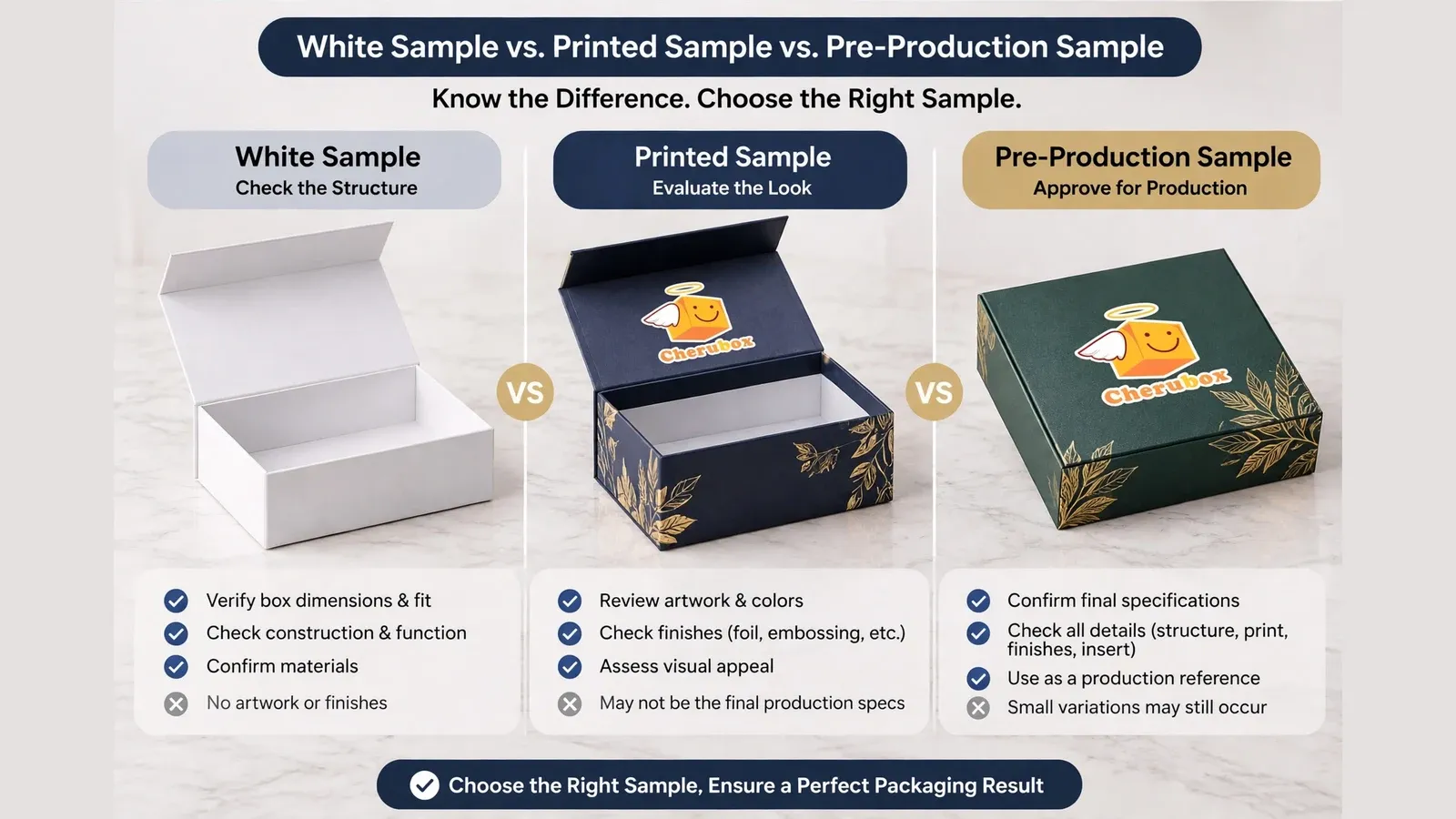
- Sample test plan: ask for a sample to evaluate structure, dimensions, product fit, printing, and finishes — and say you will test it with the real product inside. For a full checklist on what to check, see How to Check a Custom Packaging Sample Before Production. For the questions to ask a supplier before you decide, see Questions to Ask a Custom Packaging Supplier.
Share these details, and the supplier can tell you which structure fits, what to sample, and what to check before bulk production.
FAQ
Can a folding carton look premium?
Yes — with the right paperboard, printing, and finishes, a folding carton can look very good on a shelf. What it cannot do is feel like a rigid box: it is lighter, more flexible, and does not hold its shape on its own. If the premium feel has to come from the box itself, rather than from the print, a rigid box is the better choice.
Is a rigid box always better for glass bottles?
Not always, but it is the safer default for a single heavy glass bottle or a glass set. A light single serum bottle can work in a folding carton with a paperboard insert, and the straight tuck end page lists serums among its uses. The deciding factors are the bottle's weight, the bottom structure (tuck bottom versus auto-lock bottom), and whether the box will be handled roughly. Test the real bottle in a sample of each structure before deciding.
Do rigid boxes always cost more than folding cartons?
Usually, per unit, yes — a rigid box uses thicker board and more handwork, and it ships assembled. But the comparison should be on the total project cost, not the unit price alone: shipping volume, storage, assembly labour, and the number of units all change the result. A collapsible rigid box can close some of the shipping gap, but its assembly labour has to be counted too.
Can I switch from a folding carton to a rigid box for the same product?
Yes, and brands often do it for a launch or a gift edition of the same product — the serum example in this article is exactly that. The product dimensions stay the same, but the box size, board, insert, and finishes all have to be developed again for the new structure. Treat it as a new box development, not a straight swap, and order a fresh sample.
Conclusion
A folding carton is the practical default for a lightweight retail product: it is cost-effective, ships flat, and is easy to pack. A rigid box is the right choice when the box itself has to carry value — a premium launch, a gift set, a heavy or fragile product, or a box the customer will keep.
So the decision is about the product and its use, not about the box alone. A light product that is opened once and recycled belongs in a folding carton. A product whose packaging is part of the gift belongs in a rigid box.
The next step is to say what the product weighs, how it will be sold and shipped, and whether the box should be kept — then ask for a sample of the structure you prefer, with your real product inside, before bulk production.
To compare the two structures for your product, view Custom Straight Tuck End Boxes and Custom Lift-Off Lid Rigid Boxes, or contact Cherubox for a free quote: sales@cherubox.com / +86 131 6475 7116.