Buying Guides
V-Groove vs. Partially Die-Cut Rigid Boxes: What's the Difference?
Compare V-groove and partially die-cut rigid boxes, including corner appearance, production, cost, and tips for choosing the right option.
Introduction
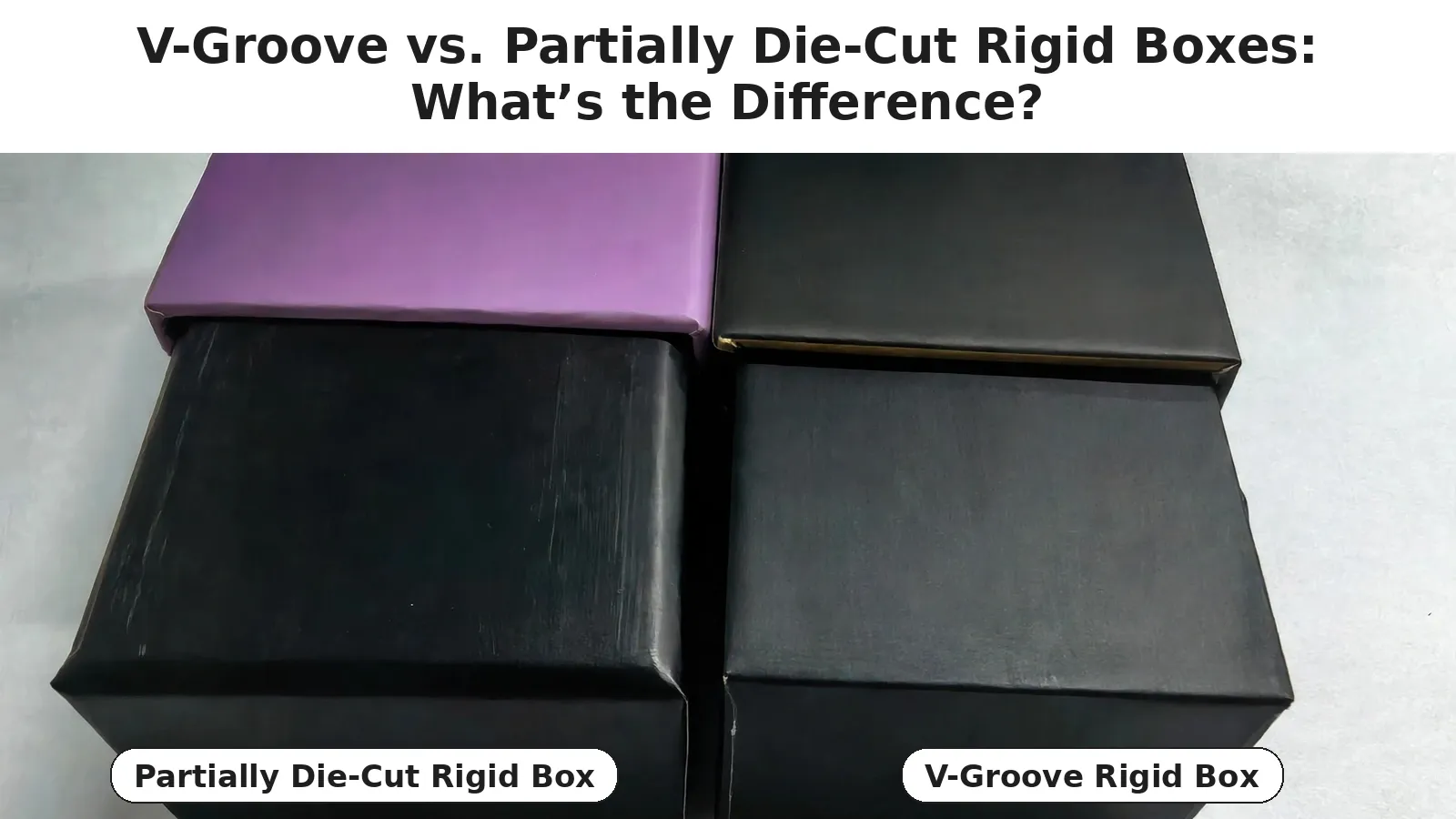
Two rigid gift boxes can have the same size, material, and printed design but look different when placed side by side. One may have sharp, well-defined edges, while the other has slightly softer corners.
One reason for this difference is how the greyboard is prepared before the box is formed. Two common approaches are V-grooving and partial die-cutting.
In this guide, we explain how the two methods work and what to consider when choosing one for your packaging. V-grooving is often chosen when edge appearance is a priority. Partial die-cutting is often chosen when you need to balance appearance and budget. The best choice depends on your product, design, and budget — and on comparing physical samples made to the same specifications.
Why This Matters
For lid-and-base rigid boxes, greyboard is commonly about 1.0–3.0 mm thick, with 1.5–2.5 mm a common choice. 2.0 mm can be used as a reference starting point when requesting a quote for an ordinary gift box. The specific choice still depends on box size, product weight, and supplier equipment.
Both V-grooving and partial die-cutting can be used to make lid-and-base boxes, drawer boxes, and other rigid packaging styles. However, they can produce different edge appearances and may affect the production process and cost.
Key Factors to Compare
What Is a V-Groove Rigid Box?
A V-groove rigid box is made using greyboard with V-shaped grooves cut along the areas where the board needs to fold.
The grooving process removes part of the board's thickness while leaving a thin connecting layer. This allows the side panels to fold up and form the box.
Once the greyboard structure is formed and secured, it can be wrapped with printed paper or specialty paper. The finished box may also include a separate lining paper and a custom insert.
V-grooving is often chosen for rigid boxes that need a clean, precise appearance. It can help create well-defined edges, especially on a rectangular box where the straight lines are an important part of the design.
Common applications:
- Premium cosmetic and skincare packaging
- Jewelry and accessory boxes
- Gift sets and presentation boxes
- Luxury product packaging
- Boxes with minimalist designs that make edge quality more noticeable
The final appearance still depends on the greyboard, wrapping paper, equipment, and overall production quality.
What Is a Partially Die-Cut Rigid Box?
A partially die-cut rigid box is made using greyboard that has been cut partway through along the folding areas. The board is not fully separated at these points, allowing the panels to fold during assembly.
The greyboard can then be formed into a lid or base, secured at the corners, and wrapped with the selected paper.
In this article, "partially die-cut" describes the folding treatment used for the greyboard. It does not mean that every rigid box made with a die-cutting process uses the same construction. The exact cuts, tooling, and assembly method may vary between suppliers.
Compared with V-grooved construction, a partially die-cut box may have a slightly softer edge. However, it can still produce a neat and attractive result when the materials and production process are well controlled.
Common applications:
- Standard rigid gift boxes
- Retail product packaging
- Promotional gift sets
- Projects with a defined packaging budget
- Boxes where a slightly softer edge is acceptable
V-Groove vs. Partially Die-Cut: Key Differences
Feature | V-Groove Rigid Box | Partially Die-Cut Rigid Box |
|---|---|---|
Greyboard preparation | A V-shaped groove is cut into the folding area | The board is partially cut at the folding area |
Material at the fold | Part of the board is removed, leaving a connecting layer | Part of the board remains uncut to connect the panels |
Typical edge appearance | Often sharper and more defined | Often slightly softer or more rounded |
Production considerations | Requires V-grooving and control of the groove | Requires suitable die-cutting and folding control |
Cost | May cost more, depending on the project | May provide a more economical option |
Best suited for | Projects that prioritize precise edges | Projects that balance appearance and budget |
These differences are general. A box's final quality depends on more than the folding method, so we recommend comparing physical samples whenever edge appearance is important.
Does V-Grooving Always Cost More?
Not necessarily. V-grooving may add a processing step and require additional equipment, but the price difference varies from project to project.
The quotation can also be affected by:
- Box dimensions and shape
- Greyboard thickness
- Order quantity
- Covering paper and lining paper
- Printing and surface finishes
- Type of insert
- Production equipment and supplier workflow
For example, a large box made with thick greyboard may have different production requirements from a small jewelry box. Similarly, the price difference at 500 pieces may not be the same as the difference at 5,000 pieces.
The best way to compare is to request quotations using the same box specifications for both options. This helps you see how much of the difference comes from the construction method.
Our article on 7 ways to reduce custom packaging costs without sacrificing quality covers other ways to review your specifications without unnecessarily sacrificing presentation.
Can You Use V-Grooving for the Lid Only?
Yes. Depending on the box structure and supplier's capabilities, the lid and base can use different construction methods.
For example:
- Lid: V-grooved greyboard
- Base: Partially die-cut greyboard
This combination may be useful when the lid is the most visible part of the package and the buyer wants to prioritize its edge appearance while reviewing the overall budget.
It is not automatically the best solution for every box. The lid and base still need to fit together properly, and their edges should look consistent enough for the intended design.
Ask your packaging supplier for a sample before approving the construction, especially if the box uses a full-coverage lid or requires a particular opening feel.
Recommended Solution
Choose V-grooving when edge appearance is a priority
V-grooving may be a good option if:
- Your box has a clean, minimalist design.
- The corners and edges will be highly visible.
- Your brand presentation calls for a more defined finish.
- You want to compare a sharper edge against your existing packaging.
For example, a plain matte gift box with only a small foil logo leaves little to distract from the shape of the box. In this case, the straightness of the edges can contribute to the overall presentation.
Consider partial die-cutting when balancing appearance and budget
Partially die-cut greyboard may be suitable if:
- You need a rigid box at a more accessible price point.
- A slightly softer edge is acceptable.
- Other design features, such as an insert or printed artwork, are the main focus.
- A physical sample meets your quality expectations.
The most useful question is not simply "Which method is better?" but "Which result meets the needs of this product and fits the packaging budget?"
What to Check on a Sample, and What to Send Before Inquiry
Before approving production, compare both samples under the same lighting and from the same angles.
Pay attention to:
- Edge definition: Are the edges straight and consistent?
- Corner alignment: Do the panels meet neatly?
- Wrapping paper: Is the paper smooth around the edges and corners?
- Lid fit: Does the lid open and close as expected?
- Box shape: Are the lid and base square and even?
- Surface finish: Are there wrinkles, exposed board, or visible marks?
- Product fit: Does the insert hold the product as intended?
If you are comparing two suppliers, share the same product information and ask each supplier to confirm the board thickness, construction, and materials. A difference in the finished samples may come from several factors, not just V-grooving or die-cutting.
You can also review our packaging dieline checklist before production before confirming artwork and production files, and see 7 things to check before approving your custom packaging sample.
For inserts, see how to design packaging inserts for product protection and 7 key factors that make a good custom packaging insert.
Before requesting a quote, prepare: box dimensions, order quantity, product details and weight, preferred greyboard thickness, covering and lining paper, printing and surface finishes, and insert type. If sharp edges are important, include that requirement in your inquiry. You can also request a comparison quote for both methods and ask to see samples or close-up photos of the edges.
Frequently Asked Questions
Is a V-groove box stronger than a partially die-cut box?
Not automatically. Box strength depends on the greyboard, box size, construction, assembly quality, and intended load. V-grooving is often selected for its edge appearance, so strength should be assessed through an appropriate sample and product-fit review.
Can both methods be used for a lid-and-base box?
Yes. Both methods can be used for greyboard lid-and-base rigid boxes, subject to the supplier's equipment and the box specifications.
Can a partially die-cut box still look premium?
Yes. Material selection, paper wrapping, printing, finishes, and careful assembly all contribute to a premium appearance. A physical sample is the best way to decide whether the edge finish meets your expectations.
Should I specify V-grooving when requesting a quote?
If sharp edges are important to your design, include that requirement in your inquiry. You can also request a comparison quote for both methods and ask to see samples or close-up photos of the edges.
Find the Right Rigid Box for Your Product
V-grooving and partial die-cutting are two ways to prepare greyboard for rigid box construction. V-grooving is often chosen for more defined edges, while partial die-cutting may offer a practical way to balance appearance and cost.
At Cherubox, we help you review the box structure, materials, finishes, and sample options based on your product and project requirements.
Ready to compare options for your packaging? Get a Free Quote or email sales@cherubox.com. Please share your box dimensions, order quantity, product details, and any preferred finishes.