Oct 30, 2026Buying Guides
Clear PET vs. Black Plastic Trays for Packaging
Clear PET or black plastic trays? Compare visibility, presentation, material choices, and product fit with a practical cosmetic packaging design example.
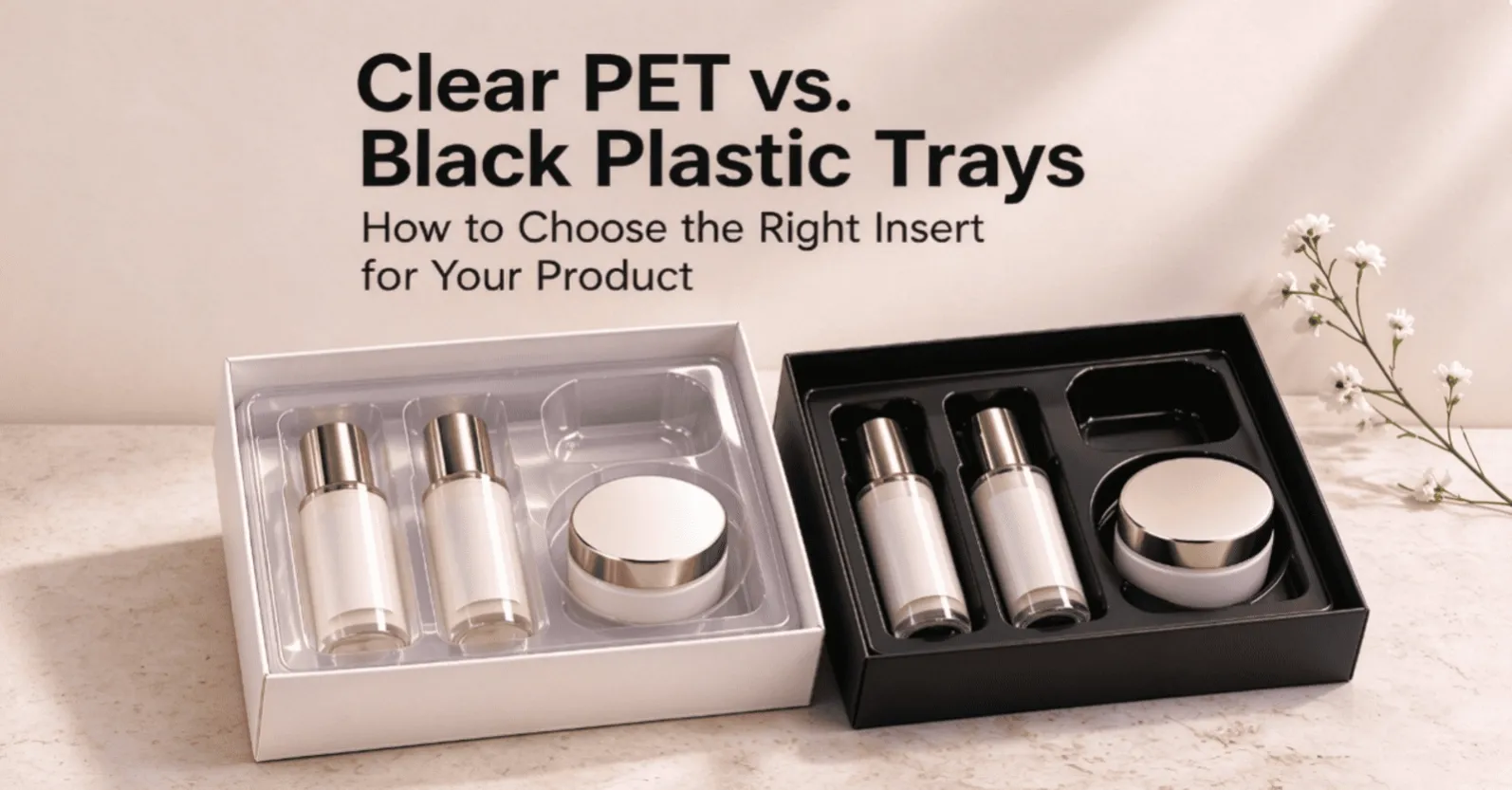
Clear PET vs. Black Plastic Trays: How to Choose the Right Insert for Your Product
The color and appearance of a plastic tray insert can significantly affect how customers perceive a packaged product.
A clear PET tray allows products and packaging graphics to remain visible. A black plastic tray creates a more defined background and can give products a contrasting, organized presentation.
Both options can work well in cosmetic gift sets, electronics packaging, retail boxes, and promotional collections.
However, the best choice depends on more than appearance. Material selection, product shape, surface durability, packaging design, and cost should all be considered.
This guide compares clear and black plastic tray inserts and explains how to choose the right option for your packaging project.
1. What Are Clear PET Tray Inserts?
Clear PET tray inserts are thermoformed plastic components commonly used to position products while allowing visibility through the tray material.
They are often selected for packaging where the buyer wants customers to see the products, printed backing cards, or interior packaging design.
Common applications include:
- Skincare gift sets
- Cosmetic collections
- Retail accessories
- Personal care products
- Promotional product kits
Clear trays can create a relatively unobtrusive presentation, but their edges, reflections, and forming marks may still be visible.
2. What Are Black Plastic Tray Inserts?
Black plastic trays are formed using suitable black-colored thermoforming sheet materials.
Depending on the project, these may include PET, PETG, PP, or other appropriate plastics.
A black tray can create strong visual contrast with light-colored products and provide a consistent background for a coordinated collection.
Common applications include:
- Premium cosmetic packaging
- Fragrance gift sets
- Electronics accessories
- Corporate gift boxes
- Specialty retail packaging
Black trays can also make cavities and product arrangements visually distinct.
However, dust, scratches, and scuff marks may be more noticeable on certain black surfaces.
3. Clear vs. Black Plastic Trays: Key Differences
Feature | Clear PET Tray | Black Plastic Tray |
|---|---|---|
Product visibility | High | Products visible from above, tray opaque |
Visual appearance | Light, transparent | Strong contrast, defined background |
Printed backing visibility | Can remain visible | Usually concealed beneath tray |
Surface reflections | May be noticeable | Depends on surface finish |
Dust visibility | Depends on lighting and surface | May be prominent on some black finishes |
Scratches | Can be visible under certain lighting | May show as lighter scuff marks |
Material options | Commonly clear PET or PETG | PET, PETG, PP, and other suitable grades |
Typical use | Product display and visibility | Premium presentation and visual contrast |
The final appearance depends on material grade, surface texture, product color, and lighting.
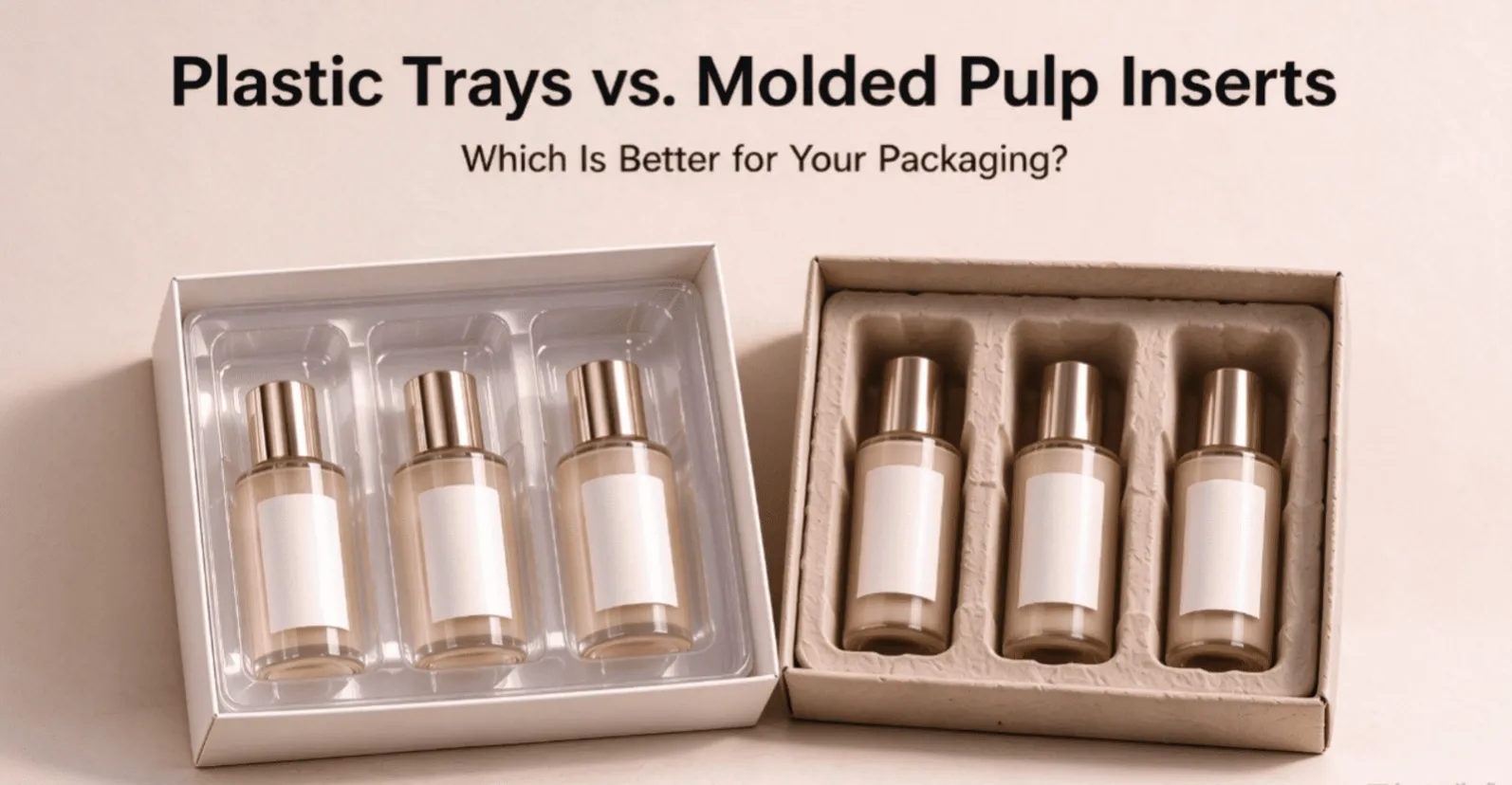
If you are still deciding whether a plastic insert is the right material for your packaging, read our comparison of Plastic Trays vs. Molded Pulp Inserts.
4. When Is a Clear Tray the Better Choice?
A clear tray may be preferable when the packaging design includes attractive graphics beneath the products.
For example, a brand may use a printed paperboard backing card with its logo, product descriptions, or decorative patterns.
A transparent tray can allow these elements to remain visible.
Clear trays can also work well when the products themselves provide the main visual interest.
However, transparent trays should be evaluated under realistic lighting because reflections and formed edges may affect the appearance.
5. When Is a Black Tray the Better Choice?
Black trays may be appropriate when the brand wants a consistent, contrasting background.
They can be especially effective for:
- White cosmetic bottles
- Metallic product components
- Glass fragrance containers
- Light-colored accessories
- Coordinated premium gift sets
A black tray can help visually separate individual products, particularly when the cavities have clean, consistent outlines.
However, black is not automatically the best choice for every luxury brand.
Cream, white, or custom-colored trays may better suit some packaging identities.
6. Illustrative Project Example: Premium Skincare Gift Box
Example status: Illustrative design scenario — not a completed Cherubox customer project.
A skincare brand is developing a rigid gift box containing two serum bottles and one cream jar.
The brand is comparing a clear PET tray with a black thermoformed plastic tray.
Example dimensions
Component | Dimensions |
|---|---|
Serum bottle | Ø35 × 115 mm (diameter × height) |
Number of serum bottles | 2 |
Cream jar | Ø65 × 45 mm (diameter × height) |
Number of cream jars | 1 |
Outer rigid box internal dimensions | 250 × 180 × 65 mm (L × W × H) |
Proposed tray outer dimensions | 246 × 176 × 40 mm (L × W × H) |
Bottle cavity opening footprint | 120 × 39 mm each |
Jar cavity opening footprint | 69 × 69 mm |
Proposed bottle cavity depth | 20 mm |
Proposed jar cavity depth | 25 mm |
Proposed tray-to-box clearance | 2 mm per side |
All measurements are illustrative design assumptions, not confirmed production specifications.
The two bottles are assumed to lie horizontally, while the cream jar stands upright.
Step 1: Plan the Product Layout
The two serum bottles are placed side by side in the left portion of the tray.
Each bottle cavity has a proposed opening footprint of 120 × 39 mm.
The cream jar is positioned on the right in a circular cavity with a proposed 69 mm opening diameter.
For illustration, the 120 mm bottle-cavity length and 69 mm jar-cavity width occupy 189 mm of the tray's 246 mm length.
This leaves 57 mm for separation and perimeter areas.
The two 39 mm bottle-cavity widths occupy 78 mm of the 176 mm tray width, leaving room for separation, structural features, and positioning of the jar.
This is a preliminary layout only. The final arrangement must account for actual product profiles, tray walls, and forming requirements.
Step 2: Evaluate the Clear PET Option
A clear PET tray could allow the printed interior of the gift box to remain visible.
This may be useful if the brand wants to include decorative graphics beneath the bottles and jar.
Potential benefits include:
- Visibility of the printed backing
- A light, minimal appearance
- Product-focused presentation
- Compatibility with various interior box colors
Potential concerns include visible reflections, formed edges, and surface marks.
Step 3: Evaluate the Black Tray Option
A black tray could create stronger contrast against white or light-colored skincare containers.
Potential benefits include:
- Defined product compartments
- A consistent dark background
- Strong visual contrast
- A coordinated appearance with dark packaging graphics
Potential concerns include dust visibility, scuff marks, and concealment of any printed backing beneath the tray.
Step 4: Compare Physical Samples
The brand should evaluate both tray colors using the same actual products and outer box.
The review should consider:
- Product visibility and contrast
- Tray reflections under normal lighting
- Surface marks and dust visibility
- Ease of product removal
- Overall packaging appearance
- Material thickness and cavity fit
- Packaging cost differences
Step 5: Select the Final Appearance
Illustrative design conclusion: A clear PET tray would be a candidate if the printed box interior and product visibility are important. A black tray would be a candidate if stronger contrast and a defined product arrangement are preferred.
The final choice should follow physical sample review.
No actual customer selection, approved sample, or production outcome is claimed in this example.
7. Does Tray Color Affect Cost?
Tray color may influence material availability, minimum order quantities, and sourcing costs.
However, a black tray is not necessarily more expensive than a clear tray, and vice versa.
Cost differences may depend on:
- Material grade
- Sheet thickness
- Color availability
- Surface texture
- Order quantity
- Tooling requirements
- Production specifications
For an accurate comparison, request quotations using the same tray dimensions and cavity design.
If the material grade or sheet thickness changes, the quotations may not be directly comparable.
8. Does a Black Tray Provide Better Protection?
Not inherently.
Tray color does not determine cushioning performance.
A clear PET tray and a black PET tray with similar construction may have comparable positioning functions, although actual material grades and forming characteristics can differ.
For fragile products, the tray's structure and the complete packaging system are more important than its color.
If substantial impact protection is required, additional foam, corrugated supports, or other cushioning solutions may be necessary.
9. How to Choose the Right Tray for Your Brand
Before selecting a tray color, ask:
What should customers notice first?
If the product and printed backing should remain visible, consider a clear tray.
If the brand wants a contrasting product arrangement, consider a black tray.
Will the tray be visible after opening?
If the tray is a major part of the unboxing experience, surface appearance becomes especially important.
Does the product have a delicate finish?
Evaluate whether the tray could scratch, rub, or mark the product.
Will the packaging be shipped internationally?
Check that the tray holds the product appropriately and that the outer packaging provides sufficient protection.
Is the selected material available at the required quantity?
Confirm material availability before finalizing the design.
10. A Practical Sampling Checklist
Check | Clear Tray | Black Tray |
|---|---|---|
Product cavity fit | Required | Required |
Tray-to-box fit | Required | Required |
Reflections | Evaluate | Evaluate |
Dust visibility | Evaluate | Evaluate |
Scratch/scuff appearance | Evaluate | Evaluate |
Product contrast | Evaluate | Evaluate |
Material grade | Confirm | Confirm |
Product removal | Test | Test |
Final appearance | Approve sample | Approve sample |
Whenever possible, compare samples under the same lighting conditions with the actual products installed.
For more details about mold design, cavity dimensions, and physical sample approval, read our guide to Custom Plastic Tray Tooling & Sampling.
Frequently Asked Questions
Is clear PET better than black plastic for cosmetic packaging?
Neither is universally better. Clear PET emphasizes transparency, while black trays can provide a contrasting background.
Can black plastic trays be made from PET?
Yes. Black PET sheet may be suitable for thermoforming, depending on the required specifications.
Are clear plastic trays more expensive?
Not necessarily. Cost depends on material grade, availability, thickness, tooling, and quantity.
Can plastic trays scratch cosmetic bottles?
Contact with tray surfaces can potentially cause rubbing or marks. Material compatibility and fit should be evaluated with actual products.
Can I use the same mold for clear and black trays?
In some cases, the same mold can be used when the tray geometry and material forming characteristics are compatible. Confirm this with the production partner.
Do clear and black trays require different minimum order quantities?
They may. MOQ depends on material availability and production requirements.
Develop Your Custom Plastic Tray Packaging with Cherubox
At Cherubox Packaging, we help brands and importers compare tray materials, review product fit, coordinate sampling, and manage production through suitable manufacturing partners.
Whether you prefer clear PET inserts or black thermoformed trays, our team can help evaluate the appearance, structure, and practical requirements of your packaging project.
Explore our custom plastic tray inserts and other packaging insert solutions.