Oct 30, 2026Buying Guides
Plastic Trays vs. Molded Pulp Inserts: B2B Guide
Compare plastic trays and molded pulp inserts for custom packaging. Explore costs, tooling, protection, appearance, and practical design examples.
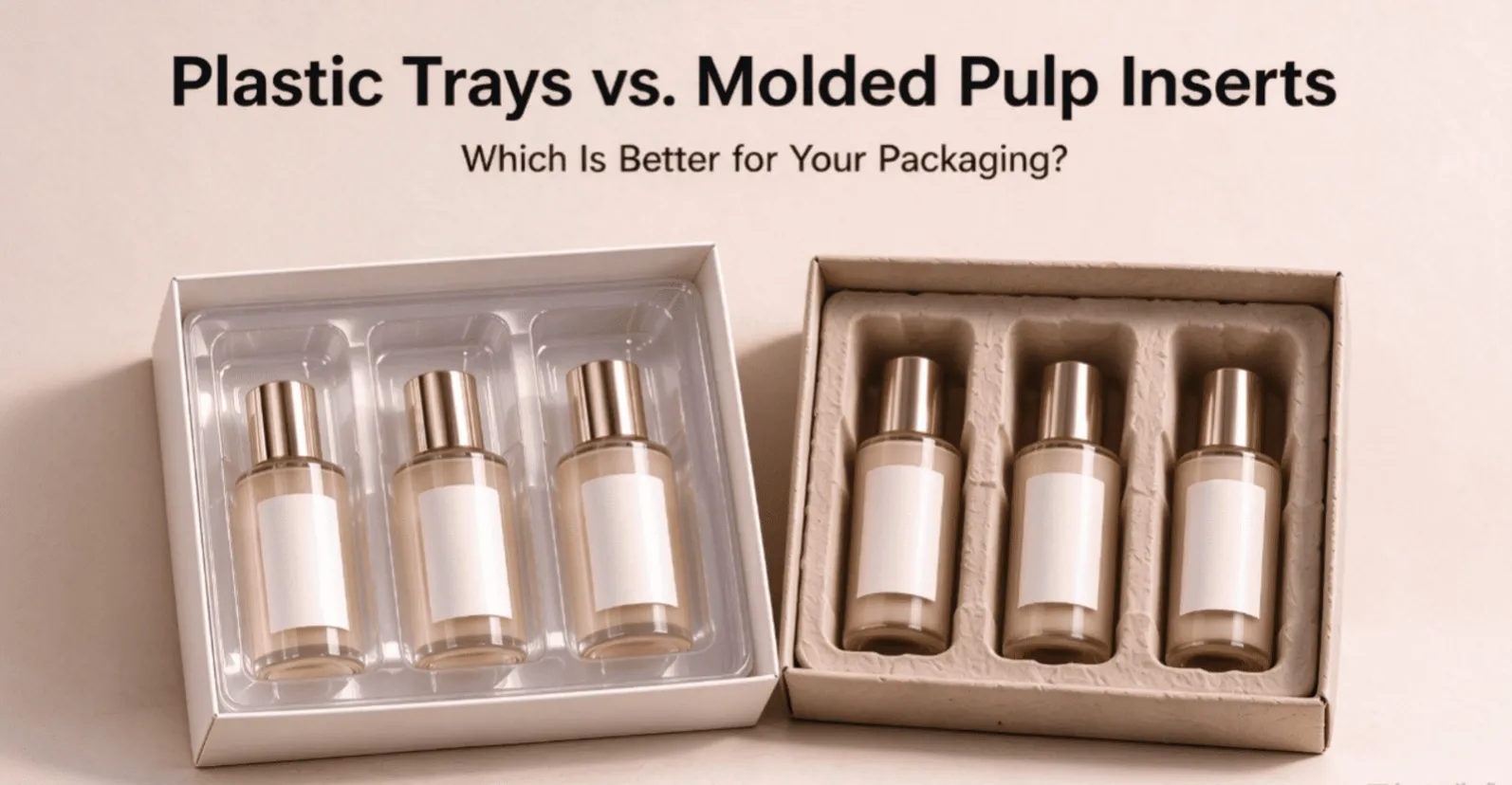
Plastic Trays vs. Molded Pulp Inserts: Which Is Better for Your Packaging?
Choosing the right packaging insert is not simply a matter of selecting plastic or paper. The insert must fit the product, support its weight, work with the outer box, and meet the brand's presentation and budget requirements.
Two common options are thermoformed plastic trays and molded pulp inserts. Both can be formed into three-dimensional product cavities, but their materials, appearance, production processes, and protective characteristics differ.
For B2B buyers developing cosmetics, electronics, gift sets, or retail packaging, understanding these differences can help prevent unnecessary tooling expenses, poor product fit, and packaging redesigns.
This guide explains when to choose each material and what to check before ordering.
1. What Are Plastic Tray Inserts?
Plastic tray inserts are commonly produced by thermoforming sheets of materials such as PET, PETG, or PP.
During production, a heated plastic sheet is formed against a mold, creating cavities that hold products in position.
Common features include:
- Clear or colored material options
- Thin-walled, shaped product cavities
- Multiple product compartments
- Lightweight construction
- Suitable structures for retail presentation
Plastic trays are particularly useful when product visibility and organized presentation are important.
However, a thin thermoformed tray should not automatically be considered a cushioning solution. Its primary function may be product positioning rather than impact absorption.
2. What Are Molded Pulp Inserts?
Molded pulp inserts are made by forming paper fibers into three-dimensional packaging structures.
Depending on the production process, molded pulp can have a natural, textured appearance or a smoother, more refined surface.
Common applications include:
- Electronics packaging
- Cosmetic gift sets
- Glass containers
- Consumer product packaging
- Protective product supports
Molded pulp can incorporate ribs, cavities, and supporting walls to help secure products.
Its actual cushioning performance depends on structural design, fiber composition, thickness, and the complete packaging system.
3. Plastic Trays vs. Molded Pulp: Key Differences
Feature | Plastic Tray Inserts | Molded Pulp Inserts |
|---|---|---|
Main materials | PET, PETG, PP | Recycled or selected virgin paper fibers |
Appearance | Clear, colored, smooth | Natural textured or smooth fiber finish |
Product visibility | Transparent options available | Generally opaque |
Structure | Thin-walled formed cavities | Molded fiber cavities and support ribs |
Tooling | Usually required | Usually required |
Cushioning | Limited in thin trays unless specially designed | Depends on molded structure and design |
Moisture behavior | Depends on plastic grade | Can absorb moisture |
Recycling | Depends on resin and local facilities | Depends on fiber, treatments, and local facilities |
Typical applications | Cosmetics, retail sets, accessories | Electronics, gift sets, protective supports |
Neither material is automatically better. The appropriate choice depends on the project.
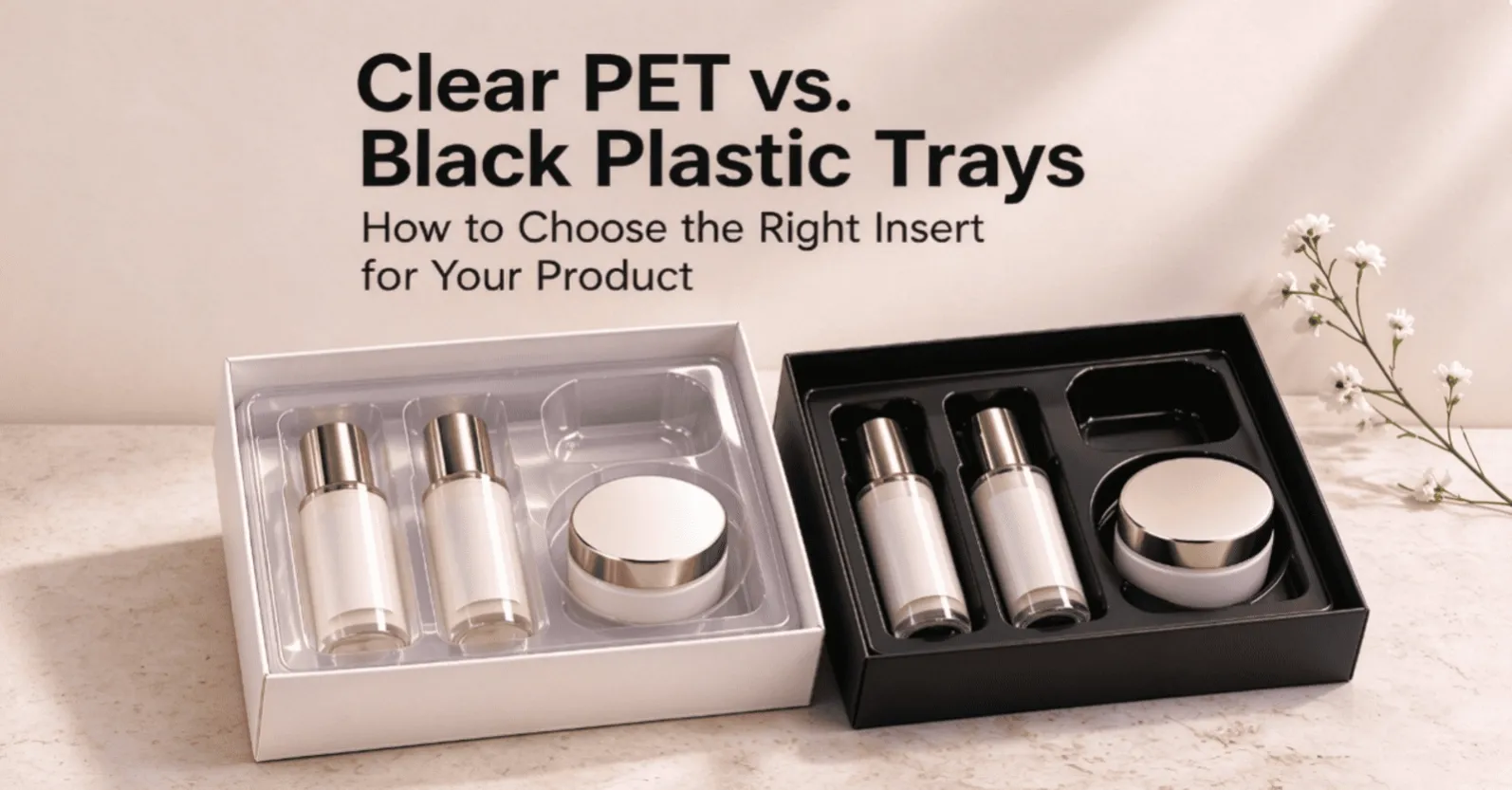
If you have already decided to use plastic inserts, the next consideration may be appearance. Our guide to Clear PET vs. Black Plastic Trays explains how tray color affects product visibility and packaging presentation.
4. Which Material Offers Better Product Protection?
Protection depends more on the complete packaging design than on material names alone.
A thermoformed plastic tray can hold bottles or accessories in a precise arrangement. However, a rigid or thin-walled cavity may transmit impact forces unless additional protective features are included.
Molded pulp can provide structural support and, when properly engineered, cushioning through its formed walls, ribs, and deformation characteristics.
For fragile products, buyers should evaluate:
- Product weight and center of gravity
- Clearance between the product and outer box
- Insert wall thickness and supporting geometry
- Expected drops, vibration, and compression
- Whether additional cushioning is necessary
A sample that looks attractive is not sufficient evidence of shipping protection. Appropriate transit testing may be needed.
5. Illustrative Project Example: Cosmetic Bottle Gift Set
Example status: Illustrative design scenario — not a completed Cherubox customer project.
Consider a skincare brand developing a gift box containing three cylindrical glass bottles.
Example dimensions
Component | Dimensions |
|---|---|
Individual bottle | Ø45 × 120 mm (diameter × height) |
Number of bottles | 3 |
Outer rigid box internal dimensions | 240 × 180 × 65 mm (L × W × H) |
Proposed insert outer dimensions | 236 × 176 × 45 mm (L × W × H) |
Proposed cavity footprint | 125 × 48 mm per bottle |
Proposed cavity depth | 25 mm |
Side clearance between insert and box | 2 mm per side |
All dimensions are illustrative design assumptions, not verified production specifications.
The bottles are assumed to lie horizontally, with their 120 mm length aligned with the 240 mm direction of the box.
The three cavities are arranged across the 180 mm box width. Their combined nominal width is 144 mm, leaving 32 mm within the 176 mm insert width for perimeter supports and spacing.
Option A: Clear PET Tray
A clear thermoformed PET tray could hold the bottles in shaped cavities, allowing the products and their labels to remain visible.
Potential advantages:
- Clean retail presentation
- Product visibility
- Relatively thin tray construction
- Clearly defined compartments
However, the cavity design would need to accommodate bottle shoulders and caps. Additional cushioning might be required for distribution.
Option B: Molded Pulp Insert
A molded pulp insert could use formed support ribs and recessed areas to position the bottles.
Potential advantages:
- Fiber-based material appearance
- Opaque support structure
- Potential to integrate protective ribs
- Suitable for brands preferring a paper-fiber packaging direction
The insert would require evaluation for surface texture, dimensional tolerances, and moisture exposure.
Proposed Design Review
Before choosing either option, the buyer should request a sample using the actual bottles.
The review should confirm:
- The bottles fit without excessive force.
- Labels and caps do not rub against cavity walls.
- Products can be removed conveniently.
- The insert remains stable inside the rigid box.
- The assembled packaging meets the intended handling and shipping requirements.
Illustrative design conclusion: A clear PET tray would be a candidate if visual presentation is the primary objective. A molded pulp insert would be a candidate if the project prioritizes a paper-fiber material and formed structural support.
No actual test result, final material selection, or customer outcome is claimed in this example.
6. Which Material Is More Cost-Effective?
Cost depends on insert size, cavity complexity, material grade, tooling, and production quantity.
For plastic trays, important cost factors include:
- Sheet material and thickness
- Tooling construction
- Cavity depth and forming complexity
- Trimming requirements
- Production volume
For molded pulp, important cost factors include:
- Fiber material
- Molding and drying processes
- Tooling
- Wall thickness and part geometry
- Surface quality requirements
- Production quantity
A lower material cost does not necessarily mean a lower total packaging cost.
For example, a tray with a low unit price but high tooling costs may be less economical for a small production run.
Buyers should request quotations showing tooling and unit costs separately.
For a closer look at tooling requirements, cavity dimensions, and sample approval, read our guide to Custom Plastic Tray Tooling & Sampling.
7. Which Option Is More Sustainable?
Molded pulp is fiber-based, while conventional plastic trays are made from polymer materials.
However, material identity alone does not determine environmental performance.
Buyers should consider:
- Recycled content
- Material weight
- Production processes
- Protective performance and potential product damage
- Local recycling infrastructure
- Coatings, adhesives, and mixed materials
Untreated molded pulp may be accepted in suitable paper recycling systems. Plastic tray recycling depends on the specific resin and local collection facilities.
Avoid describing either material as universally recyclable without verifying the actual construction and destination market.
8. When Should You Choose Each Insert?
Consider plastic trays when:
- Transparent product display is important.
- The packaging requires thin-walled cavities.
- A smooth, colored surface is preferred.
- Multiple retail products need organized positioning.
Consider molded pulp when:
- A fiber-based insert is preferred.
- An opaque, natural material appearance suits the brand.
- The design benefits from molded ribs or supporting structures.
- The product and packaging are compatible with molded fiber characteristics.
For products requiring substantial cushioning, additional foam, corrugated supports, or other protective components may be necessary.
9. Questions to Ask Before Ordering
Before requesting a quotation, prepare the following information:
- Product dimensions, including caps and labels
- Product weight and material
- Number of items per box
- Outer box internal dimensions
- Preferred insert material and color
- Expected shipping method
- Estimated order quantity
- Whether tooling and physical samples are required
Providing accurate specifications early can reduce unnecessary revisions.
Frequently Asked Questions
Are molded pulp inserts always cheaper than plastic trays?
No. Total costs depend on material, tooling, geometry, finishing requirements, and production volume.
Are plastic trays better for cosmetic gift sets?
They can be a good choice when transparency and product visibility are priorities. Molded pulp may be preferable for a different material appearance or support design.
Can molded pulp protect glass bottles?
Properly designed molded pulp can provide support and cushioning, but fragile products should be evaluated through suitable packaging tests.
Do both options require custom molds?
Custom three-dimensional designs generally require tooling for both thermoformed plastic and molded pulp.
Can both materials be used inside rigid boxes?
Yes. Both can be designed to fit suitable rigid packaging structures.
Can plastic trays be transparent and colored?
Yes. Clear and selected colored plastic materials can be considered depending on the material grade and forming requirements.
Find the Right Packaging Insert with Cherubox
At Cherubox Packaging, we help brands, importers, and wholesalers compare packaging materials, review insert structures, and coordinate sampling and production with suitable manufacturing partners.
Whether you need clear thermoformed trays or custom molded pulp supports, our team can help evaluate a practical solution for your products.
Explore our custom plastic tray inserts and molded pulp insert solutions.