Buying Guides
Collapsible Rigid Box vs Set-Up Rigid Box: Which Cuts Freight and Storage Costs Without Losing the Luxury Feel?
Compare collapsible and set-up rigid boxes on freight, storage, assembly, and luxury feel, and learn what to check before you choose.
Introduction
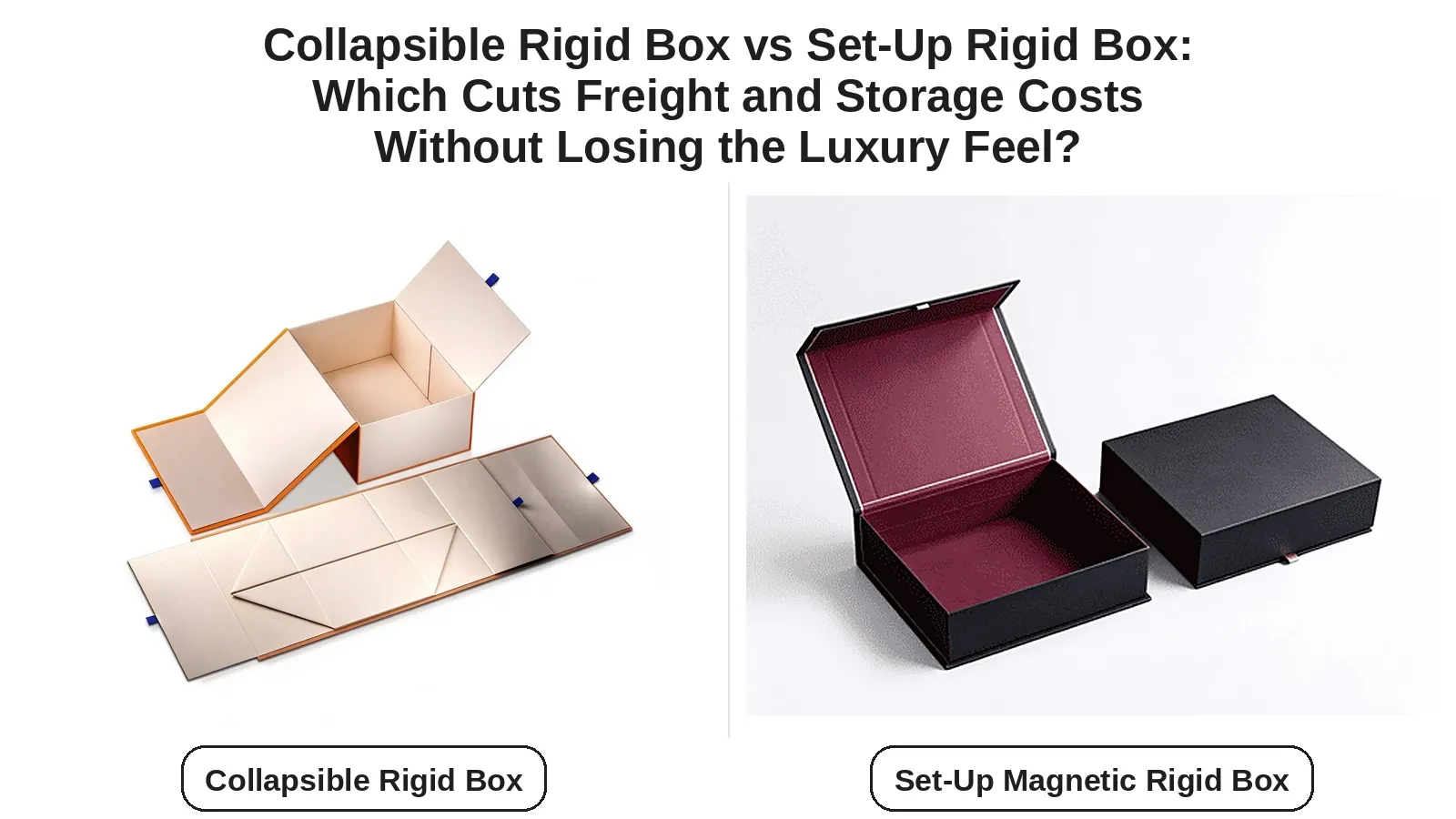
If freight and warehouse space are eating into your packaging budget, a collapsible rigid box looks like the obvious answer: it ships flat, so it takes up less volume than a set-up rigid box that arrives fully assembled.
That is only half of the answer. A collapsible box can reduce shipping volume and warehouse space, but the final saving is not decided by volume alone. It depends on box dimensions, order quantity, assembly labour, packing configuration, and transportation method. A collapsible box also has to be assembled before use, and its folding panels, corner connections, adhesive placement, and closure alignment all have to work after assembly.
A set-up rigid box, by contrast, arrives ready to use. It takes up full volume in shipping and storage, but there is no assembly step, and its shape is fixed from the start.
So the real question is not "which box is cheaper to ship?" It is: does the volume you save with a collapsible box outweigh the assembly work it adds, while the finished box still looks and feels like a luxury rigid box? After reading this article, you will be able to judge that trade-off for your own product, and know what information to send a supplier for a like-for-like comparison.
Why This Choice Matters
Freight and storage are not a small line on a rigid box project. A set-up rigid box is mostly empty space inside: every box you ship is a finished box, with its full height, width, and depth. When you order in bulk, that volume adds up in cartons, in warehouse shelves, and in the truck or container.
A collapsible rigid box changes that starting point. It is packed flat and assembled when needed, so the same number of boxes can take up less shipping volume and warehouse space than many fully assembled rigid boxes. That is why collapsible boxes are often chosen for bulk orders, for brands and importers who store packaging before packing, and for gift sets that are assembled closer to the point of use.
But the saving only counts if the assembled box still does its job. A gift box has to protect the product, open and close cleanly, and look premium when the customer receives it. If a collapsible box is hard to assemble, sits unevenly after assembly, or its closure does not align, the freight saving is not worth it.
This is why the choice is a trade-off, not a default. Collapsible wins on volume. Set-up wins on readiness. The right choice depends on who assembles the box, where it is assembled, and how the finished box will be handled.
Key Factors to Compare
Shipping and Storage Volume
A set-up rigid box ships exactly as it will be used: lid and base formed, height included. A collapsible rigid box ships flat, so the shipment is flatter and can be packed more densely.
That difference matters most when the box is large, the order quantity is high, or the boxes have to be stored for a long time before packing. It matters less when the box is small, the quantity is low, or the boxes are packed and shipped out almost immediately after they arrive.
Do not judge the saving on volume alone. The product page for Custom Collapsible Rigid Boxes states it directly: while flat-pack construction can reduce shipping and storage volume, the final cost savings depend on box dimensions, order quantity, assembly labour, packing configuration, and transportation method. The same point is repeated in its FAQ: a collapsible box can reduce shipping volume, which may lower transportation and storage costs, and actual savings depend on carton dimensions, shipping method, order quantity, and assembly requirements.
In other words, flat does not automatically mean cheaper overall. It means less volume. Whether that turns into a lower total cost depends on everything else in the shipment.
Assembly Time and Labour
This is the biggest difference between the two structures, and the one most often missed in a first quotation.
A set-up rigid box needs no assembly. It can be filled as soon as it is taken out of the carton.
A collapsible rigid box needs to be assembled before use. Most designs use foldable panels and pre-applied adhesive strips or other fastening systems, and assembly steps vary depending on the structure. That means someone has to do the work: your own team, a packing partner, or the factory before dispatch. The time that takes, and whether the person assembling the box has done it before, is part of the real cost.
When you compare the two, ask who assembles the box and where. If assembly happens in your own warehouse with trained staff, a collapsible box may fit well. If the boxes are sent to a third party for packing, or assembled by hand at a pop-up or event, the assembly step needs to be tested first, not assumed.
Samples are the way to test this. Cherubox arranges samples to check assembly, structural stability, closure alignment, printing, and finishing details before bulk production for collapsible boxes. For lift-off lid boxes, samples are arranged to evaluate lid fit, box structure, materials, printing, and finishes. Use the sample to time the assembly and to check the finished box, not only to look at the print. For a full checklist on what to check, see How to Check a Custom Packaging Sample Before Production.
Rigidity and Luxury Feel After Assembly
A set-up rigid box is formed once, and its shape is fixed. Its thick paperboard gives it structural support, and the lid and base fit is set during production. For a lift-off lid box, that fit is essential: if the lid fits too tightly, it may be difficult to remove; if the fit is too loose, the lid may shift during handling. Lid depth, paper thickness, wrapping materials, and dimensional tolerances should be reviewed during structural development.
A collapsible rigid box has to reach the same standard after it is folded up. Its thick paperboard and quality wrapping materials provide a refined presentation after assembly, according to the product page. But that presentation depends on the folding panels, corner connections, and adhesive placement working as intended. The box must hold its shape, sit flat, and close properly once assembled.
Greyboard thickness is part of this, but it is not a number to guess. For lid-and-base rigid boxes, greyboard is commonly about 1.0–3.0 mm, with 1.5–2.5 mm a common choice, and 2.0 mm as a reference starting point for an ordinary gift box inquiry. The specific choice still depends on box size, product weight, and supplier equipment. That range is a starting point for discussion, not a specification for every box. For a collapsible box, the board also has to fold cleanly and hold its shape after folding, so the board choice should be reviewed together with the folding structure, not chosen on thickness alone.
The practical test is simple: assemble the sample, put the product inside, close the box, and handle it the way a customer would. Does it feel rigid? Does it sit flat? Does it open and close cleanly more than once? If the answer is not yes on the sample, it will not be yes in bulk.
Inserts and Packing
Inserts behave differently in the two structures.
In a set-up rigid box, the insert can be fitted to a fixed interior. For a Custom Lift-Off Lid Rigid Box, paperboard, moulded pulp, EVA foam, or other foam inserts help keep products securely positioned, and the insert can be checked against the finished box.
In a collapsible rigid box, the insert must be designed to fit the assembled box, and it may need to be packed separately. The product page lists foldable paperboard inserts, foam, EVA, or other compatible options for collapsible boxes. That means the insert and the box are two separate packing steps, not one. If the insert is rigid and the box arrives flat, the insert may take up the space the flat box was meant to save.
When you plan the order, ask how the insert will be packed and when it will be fitted. A foldable paperboard insert can travel with the flat box more easily than a thick foam insert. A fitted foam insert may need its own carton and its own assembly step. For guidance on insert types, see Packaging Inserts: A Complete Guide.
Closure and Opening Experience
The closure is part of the luxury feel, and it is also where a collapsible box can differ most from a set-up box.
A set-up lift-off lid box opens by lifting the lid off the base. The experience is simple and repeatable, and the fit between lid and base is the main thing to get right.
A collapsible rigid box can use a magnetic flap, a tuck-in closure, or another compatible design, selected based on the structure. Certain collapsible structures can incorporate concealed magnets for a convenient closure. But for magnetic collapsible boxes, magnet positioning and closure alignment should also be reviewed to ensure proper functionality after assembly. A magnet that is well placed on a flat panel may sit differently once the box is folded and assembled, so the closure should be checked on an assembled sample, not only on a flat sheet.
If the box will be opened and closed more than once by the customer, test that too. Open it, close it, and open it again. The closure should feel the same on the second and third opening as it did on the first.
Recommended Solution
Use this table as a first filter. It does not replace a sample or a quotation, but it shows which structure fits which situation.
Factor | Collapsible Rigid Box | Set-Up Rigid Box (e.g. Lift-Off Lid) |
|---|---|---|
Shipped state | Packed flat, assembled when needed | Shipped fully assembled, ready to use |
Shipping and storage volume | Lower volume than many fully assembled boxes; saving depends on dimensions, quantity, packing, and transport method | Full volume; every box ships at its finished size |
Assembly | Required; foldable panels with pre-applied adhesive strips or other fastening systems; steps vary by structure | None; fill and close |
Rigidity and feel | Premium appearance after assembly, if folding, corners, adhesive, and closure alignment are correct | Fixed shape; thick paperboard gives structural support; lid-to-base fit is the key check |
Inserts | Foldable paperboard, foam, EVA, or other compatible options; insert must fit the assembled box and may be packed separately | Paperboard, moulded pulp, EVA foam, or other foam inserts fitted to a fixed interior |
Closure | Magnetic flap, tuck-in closure, or custom design; magnet position and alignment must be checked after assembly | Removable lid (full-cover or partial-cover); fit must be neither too tight nor too loose |
Best for | Bulk orders, long storage before packing, importers and distributors, gift sets assembled near the point of use | Retail-ready gift boxes, products that must be packed quickly, boxes that will be opened and closed repeatedly |
Choose a collapsible rigid box when: the order is large enough that flat packing saves real volume, the boxes will be stored before packing, and you have someone to assemble them reliably. Test the assembly on a sample first, and confirm the insert packing plan at the same time.
Choose a set-up rigid box when: the box must be ready to fill on arrival, the packing team has no assembly step, or the product needs a fixed lid-to-base fit that is checked once in production rather than on every assembly. A lift-off lid box is the classic example: a separate removable lid and a sturdy base, with a clean, elegant appearance and convenient access to the product inside.
If you are still unsure: send the same product and shipping details for both structures and compare them like for like. The comparison only works if both quotations are based on the same box size, the same product weight, the same insert, and the same shipping plan. For what a quotation should list, see How Much Do Custom Packaging Boxes Cost? and How to Reduce Custom Packaging Costs. For the questions to ask a supplier before you decide, see Questions to Ask a Custom Packaging Supplier.
What Information to Send Before Inquiry
A supplier cannot compare a collapsible box and a set-up box from a product name alone. Send the same details for both, so the comparison is fair:
- Product and box size: product dimensions and weight, and the inside size the box must hold. Box size is fully customised to product dimensions for both structures.
- Order quantity: the number of boxes, and whether this is a one-off order or a repeat. Quantity is based on project specifications; minimum order quantity depends on box dimensions, materials, structure, printing requirements, and order complexity, so a project-specific quotation is needed.
- Structure preference, if any: collapsible, lift-off lid, or no preference — ask the supplier to advise. If you want a magnetic closure, say so, and ask how magnet positioning and closure alignment will be checked after assembly for a collapsible box.
- Shipping and storage plan: how the boxes will be shipped (sea, air, courier), how long they will be stored, and who will assemble them. This is the information that decides whether flat-pack volume actually saves money.
- Insert and product protection: what the insert must hold, and whether the insert will be packed with the box or separately. Say whether the product is heavy, fragile, or made of glass, and how it will be handled in transit.
- Printing and finishes: artwork, colours (CMYK and Pantone spot colours are available for both structures), and surface finishes. Both structures offer matte or gloss lamination, foil stamping, embossing, debossing, and spot UV. For finishes, see Packaging Finishes Guide.
- Dieline and artwork: if you already have a dieline, send it. If not, ask what the supplier needs before a sample can be made. For what to check on a dieline, see Packaging Dieline Checklist Before Production.
Share these details, and the supplier can tell you which structure fits, what to sample, and what to check before bulk production.
FAQ
Does a collapsible rigid box always save money on freight?
No. It can reduce shipping volume, which may lower transportation and storage costs, but actual savings depend on carton dimensions, shipping method, order quantity, and assembly requirements. Assembly labour, packing configuration, and the way inserts are packed also affect the total. Do not assume flat-packed is always cheaper overall.
Will a collapsible rigid box feel as premium as a set-up rigid box?
It can, if the structure is right and the sample passes. A collapsible box uses thick paperboard and quality wrapping materials to give a refined presentation after assembly. The test is on the assembled sample: does it hold its shape, sit flat, and close cleanly? If the folding panels, corner connections, adhesive, and closure alignment are correct, the finished box should feel rigid. If any of those are wrong, the feel will show it.
Who should assemble a collapsible rigid box?
That depends on your packing plan. Some brands assemble the boxes in their own warehouse; others ask a packing partner or the factory to assemble them before dispatch. Assembly steps vary by structure, so whoever assembles the box should try it on a sample first and time the work. If no one on your side can do the assembly, a set-up box may be the simpler choice.
Can a collapsible rigid box use a magnetic closure and a custom insert?
Yes, in many cases. Certain collapsible structures can incorporate concealed magnets, and inserts can be foldable paperboard, foam, EVA, or other compatible options. Both need to be checked on an assembled sample: the magnet position and closure alignment after assembly, and the insert fit inside the assembled box. The insert may need to be packed separately, so confirm the packing plan before you order.
Conclusion
A collapsible rigid box cuts volume. A set-up rigid box cuts assembly. Neither is the right answer for every order.
Choose collapsible when the volume saving is real — a large order, long storage, or a long shipping leg — and when assembly can be done reliably and tested on a sample. Choose set-up when the box must be ready to fill on arrival, or when a fixed lid-to-base fit and a simple opening experience matter more than the volume saved.
The next step is to send the same product, quantity, and shipping details for both structures and ask for a like-for-like comparison, with a sample to check assembly, closure alignment, and insert fit before bulk production.
To compare the two structures for your product, view Custom Collapsible Rigid Boxes and Custom Lift-Off Lid Rigid Boxes, or contact Cherubox for a free quote: sales@cherubox.com / +86 131 6475 7116.