Buying Guides
What Should Be Included in a Packaging RFQ?
Learn what to include in a packaging RFQ: product details, structure, quantity, printing, finishes, inserts, and delivery — and how to compare the quotes you get back.
Introduction
An RFQ — a request for quotation — is the set of specifications you send a packaging supplier so they can price your box. It is not a casual email asking "how much for a box?" It is the document the quote is built on: the product, the structure, the quantity, the printing, the finishes, the inserts, and the delivery.
A complete RFQ gets you an itemized quote you can compare with other suppliers on equal terms. A thin RFQ gets you a guess, a wide price range, or a quote that changes once the real specifications surface — usually after you have already committed time to the supplier. The difference between the two is rarely the supplier. It is what you sent them.
After reading this article, you will know every item a supplier needs to price a custom packaging job, why each item changes the price, and how to compare the quotes that come back — so the cheapest-looking quote is not mistaken for the cheapest job.
Why a Complete RFQ Matters
The short answer: a quotation is only as accurate as the specifications behind it. A supplier can only price what you describe. Everything you leave out, the supplier has to assume — and different suppliers assume differently, so their quotes stop being comparable.
Cherubox's own pricing guide says it directly: the more complete your specifications are, the easier it is for a supplier to provide a meaningful quotation. And when quotes are compared, they should be compared on equivalent specifications — a quote for a simple folding carton is not directly comparable with one that includes a custom insert, premium finishes, and export delivery.
The supplier questions guide makes the same point from the other side. A good quote is judged by its scope, not just its unit price: whether it includes structural development, sampling, printing plates or tooling, special finishes, inserts, assembly, and export packing — plus shipping, which is often quoted separately. A bare-bones quote is a red flag precisely because the add-ons only appear after you commit.
So the RFQ is not paperwork for its own sake. It is how you make suppliers price the same box, so the comparison is honest and the final cost holds no surprises.
What to Include in a Packaging RFQ
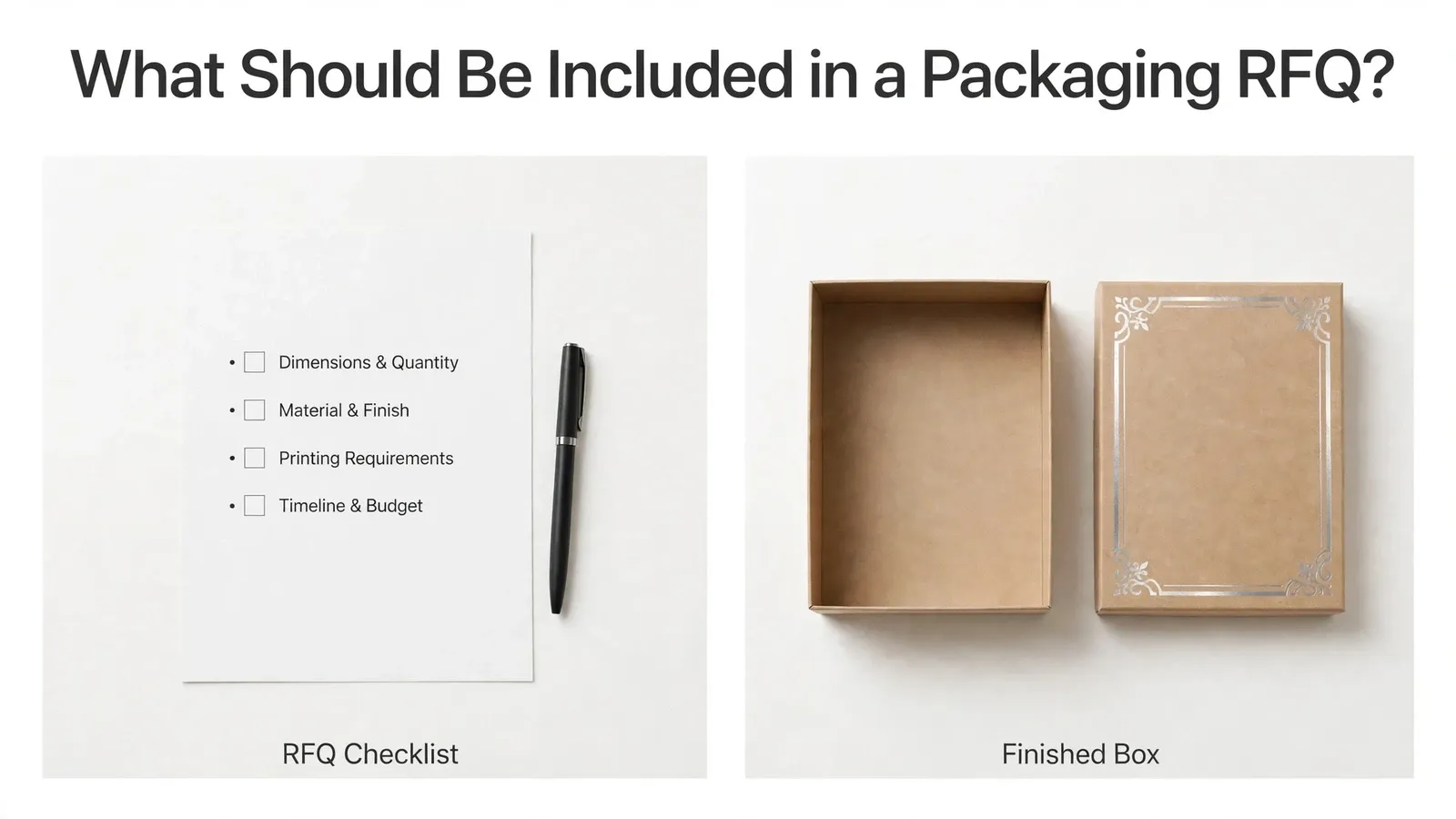
The table below is the backbone of the RFQ — the same list Cherubox's own buying guides ask buyers to send before inquiry, covering the product, the structure, the artwork, the finishes, the inserts, and the shipping plan. Each item is explained below the table.
RFQ item | What to specify | Why it changes the quote |
|---|---|---|
Product and weight | Product type, dimensions, weight, material; caps, labels, protruding parts; fragile points | Decides the structure, the board, and the insert |
How the box will be used | Retail shelf, e-commerce shipping, gift set, launch, keepsake | Decides protection, presentation, and whether the box must survive shipping |
Structure and closure | Box type and closure; lift-off lid, magnetic, drawer, collapsible, tuck end, auto-lock bottom, sleeve | Different structures need different materials, processes, and assembly |
Dimensions and units | Length, width, height; internal vs. external; units (mm or inches) | Internal dimensions decide fit; external dimensions decide shipping and storage |
Material and board | Paperboard, kraft, corrugated, rigid greyboard, specialty papers; board type and thickness | Material and board grade drive cost and performance |
Quantity | Estimated order quantity; ask for prices at several quantities | Setup costs spread across more units; quantity changes the unit price |
Printing and colours | Artwork files, dieline, CMYK and Pantone spot colours, print surfaces, inside/outside | Colour count, coverage, and print method change setup and unit cost |
Finishes | Each finish named, with where it goes: foil, embossing, debossing, spot UV, lamination | Every finish is a separate process with its own tooling and setup |
Inserts | What the insert must hold, product layout, number of items per box, insert material | Inserts add material, tooling, and assembly — and change the box size |
Artwork and dieline | Artwork files, dieline, version; reference sample or photos if available | The dieline is the production template; the wrong version means the wrong box |
Delivery and shipping | Delivery country and postal code, shipping method, packing and storage plan | Freight can be a substantial part of the total cost, especially overseas |
Timing and samples | Required delivery date; sample test plan | Sampling, approval, production, and shipping are separate stages |
The Product and How the Box Will Be Used
Start with the product, because every other decision follows from it. Give the product type, its dimensions and weight, and its material — glass bottle, jar, tube, or set. Include the parts buyers forget: caps, pumps, lids, closures, wrappers, labels, seams, and anything that protrudes. Cherubox's inserts guide makes this a measuring rule: measure every product that will sit inside the insert, including accessories that share the box, and identify the fragile points — a glass bottle's shoulders, a delicate surface, a corner that cracks easily — because the insert is designed around those weak points, not just the overall footprint.
Then say how the box will be used: retail shelf, e-commerce shipping, gift set, launch, or keepsake — and whether the customer is meant to keep the box. A light retail product that is opened once and recycled needs a different box from a gift set whose packaging is part of the gift. The supplier questions guide puts it the same way: a capable supplier asks about product dimensions, weight, fragility, retail environment, and shipping method before recommending anything — a supplier quoting materials off a price list without a single question about your product is a red flag.
Structure, Dimensions, and Materials
Name the structure and closure if you have a preference — rigid box (lift-off lid, magnetic, drawer, collapsible) or folding carton (straight tuck end, reverse tuck end, auto-lock bottom, sleeve). If you have no preference, say so and let the supplier recommend. Either way, the structure is one of the first decisions that affects cost, because different box styles require different materials, manufacturing processes, and assembly work.
Give dimensions as length, width, and height — and say whether they are internal or external. Internal dimensions decide how the product fits; external dimensions affect storage, master-carton planning, and shipping. Confirm the measurement units too: millimetres and inches should never be mixed or misread between teams. Cherubox's dieline guide adds a check buyers miss: for products with an insert, check the box and insert together, because a box at nominal size may still be unsuitable if the insert eats the space or blocks loading. The inserts guide warns of the same mistake from the other side — choosing the insert material after the box size is locked, when the insert occupies internal space and can change the required box size.
For materials, name the board and paper: paperboard for folding cartons and lightweight retail packaging, kraft paperboard for a natural look, corrugated board for cushioning and shipping strength, rigid greyboard as the solid core of premium rigid boxes, or specialty papers where the design needs them. Board thickness and grade matter too — a heavier board may improve stiffness, but the thickest option is not always necessary. The pricing guide's rule is to select material based on product weight, fragility, stacking requirements, and intended use, not simply on the lowest price or the thickest board.
Quantity, Delivery, and Timing
Give an estimated order quantity — and ask for prices at several quantities. The pricing guide recommends exactly this: request quotations at several quantities, because many packaging processes involve fixed setup costs (printing preparation, tooling, machine setup) that spread across more units, so the average cost per box often decreases at higher volumes. Compare the unit-price reduction with the extra cash and inventory commitment before deciding how much to order.
For delivery, give the country and postal code, or the complete delivery address, plus the shipping method and how the boxes will be shipped and stored. Freight can be a substantial part of the total packaging budget for overseas buyers, and the final shipping cost depends on destination, shipment weight, outer carton dimensions, shipping method, and carton count. Flat-packed folding cartons and mailer boxes often use shipping space efficiently; assembled rigid boxes generally occupy more volume, which can increase freight costs even when their product weight is relatively low.
For timing, give a required delivery date — and ask the supplier to separate sampling, artwork approval, mass production, and shipping into distinct stages. The supplier questions guide warns against a single fuzzy date with no breakdown: a delay in one stage changes the final delivery date, and production cannot begin until artwork, sample, or specifications are approved.
Printing, Colours, and Finishes
Send the artwork files and the dieline, and name the colours: CMYK and Pantone spot colours where used, which Pantone must be matched, and what reference it is matched against. Say which surfaces are printed, inside and outside. Colour requirements matter because full-colour artwork, solid background coverage, and printing on multiple surfaces may increase cost compared with a simpler design — and the print method itself (digital, offset, flexographic) depends on the box material, print coverage, quantity, and artwork.
Name every finish separately, with where it goes: foil stamping, embossing, debossing, spot UV, raised spot UV, matte or gloss lamination, soft-touch lamination. Each finish is a separate process, not a line in a description. Foil stamping uses heat, pressure, and a custom metal die to transfer foil onto targeted areas; embossing and debossing reshape the paperboard surface with custom dies; spot UV applies a clear glossy coating only to selected areas and needs its own artwork separation. The dieline guide's rule applies here too: finishing layers must be clearly identified and correctly positioned — Pantone colours, foil stamping, embossing, debossing, and spot UV as separate layers in the right places — and a spot UV layer may need to be a defined spot-colour separation while foil stamping may need its own layer marking exact stamp areas.
Use finishes selectively. The pricing guide notes that applying several effects to the entire box is generally more expensive than using them selectively — foil stamping a logo may provide a strong branding effect without the expense of applying foil across a large surface. The finishes guide agrees: use foil to highlight just one or two core design elements instead of covering large surfaces.
Inserts and Protection
Say what the insert must hold and whether the product is fragile, with the product layout and the number of items per box. Name the insert material if you have a preference — paperboard for lightweight retail products, corrugated board for heavier products and shipping protection, molded pulp for sustainable shipping inserts and fragile items, foam or EVA for high-value, fragile, or irregular products, or specialty materials such as velvet or flocked surfaces for luxury presentation. The right choice depends on product shape, fragility, weight, appearance, and the level of protection required.
Do not treat the insert as an afterthought in the RFQ. Inserts help position products, prevent movement, and improve presentation — and they can add a meaningful amount to the total packaging cost. They are also tested as a complete system with the product and the box: product movement, protection, insert stability, presentation, ease of removal, whether the insert damages the product, and whether it affects box closure. Say in the RFQ that you will test the insert with the real product inside, not on its own.
Artwork, Dieline, and Reference Sample
Attach the artwork files and the dieline, and say which version they are. A dieline is the flat template that guides cutting, folding, and assembly — cut lines tell the machine where to trim, fold lines show where the board bends, glue areas hold the box together, bleed is the extra artwork past the cut edge, and the safe area keeps important text and logos away from vulnerable edges. The dieline guide's version-control rule belongs in the RFQ: confirm the dieline version matches the approved structure, artwork is updated to the latest template, fonts and images are embedded — and do not trust filenames, because a file called "final" may not be the latest. Use revision dates or version numbers.
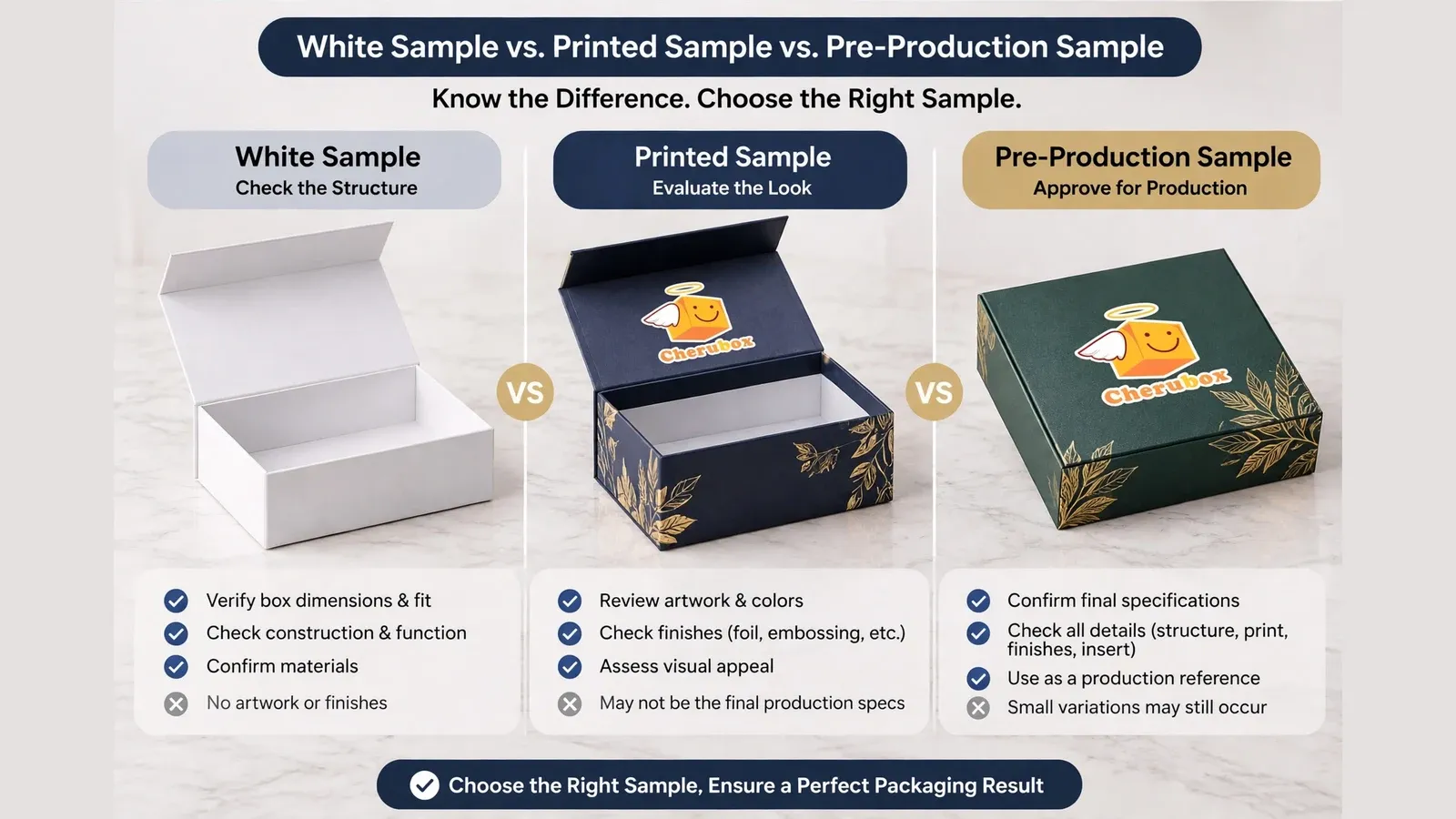
If you have a reference sample, a structural drawing, or photos of an existing box, share them with the supplier. And include a sample test plan: ask for a sample to evaluate structure, dimensions, product fit, printing, and finishes — and say you will test it with the real product inside. Cherubox's sample guide lists the seven areas to check: dimensions, product fit, structure and closure, printing and colour, special finishes, inserts and protection, and real-world use.
How to Compare the Quotes You Get Back
Ask for an itemized quotation where possible. Then check what it includes and what is billed separately. A custom packaging quotation may include separate charges for die-cutting tooling, printing plates, structural design or engineering, prototype samples, printed pre-production samples, and colour matching or special finishing setup. Not every project incurs all these fees, and suppliers may include some services in the quoted unit price — so before comparing quotations, ask which charges are included, which are billed separately, and whether any one-time costs apply again to repeat orders. For repeat production, an existing die may be reusable if the structure remains unchanged and the tooling is still available and suitable.
Compare on total landed cost, not on unit price alone. The pricing guide breaks the total into box production, printing and finishing, inserts, sampling and tooling, export packing, freight, and other applicable charges such as delivery, duties, taxes, or customs-related costs under the agreed terms. One supplier may quote a lower unit price but charge separately for tooling, inserts, and freight; another may have a higher production price but include more services. Neither is automatically better — the question is which quotation offers the best combination of specification, quality, reliability, and total cost.
For a rough sense of scale while budgeting, Cherubox's pricing guide gives broad indicative ranges at small-to-medium order quantities — folding cartons $0.05–$2.50, corrugated mailer boxes $0.50–$8.00, rigid gift or luxury boxes $2.00–$15.00 per unit — and states clearly that these are broad budgeting estimates, not guaranteed market prices or Cherubox quotations. Actual prices may fall outside these ranges depending on dimensions, order quantity, material, printing, finishing, inserts, and delivery requirements. Use them to sense-check a quote, never as a target price.
Check the Final Artwork Against the Quote Before Production
One item belongs in every RFQ even though it is not a specification: the rule that the final artwork will be compared with the quotation, finish by finish, before production. A real Cherubox case shows why. A quotation listed matte lamination, spot UV, and gold foil stamping; the final artwork specified matte lamination, gold foil — and silver foil instead of spot UV. The artwork was used as the production reference, but the difference between the quotation and the submitted design was never separately clarified, and it later became a disagreement over the finishing requirements.
The lesson from that case is that a quotation and a final artwork file serve different purposes. The quotation establishes the agreed commercial specifications and pricing basis; the final artwork communicates the design details and production instructions. Ideally, both documents match before manufacturing begins — and a design file may be technically ready for production while still containing specifications that differ from the approved quotation.
So write the comparison into your RFQ and your approval process: review the approved quotation and the final production file side by side, checking box structure, dimensions, paperboard material, printing colours, Pantone requirements, surface lamination, spot UV areas, foil stamping colours, embossing or debossing, and quantity. Use a separate finishing specification — for example, "Exterior: Matte lamination + gold foil stamping + spot UV" — rather than relying only on the visual appearance of the artwork. And if the final artwork differs from the quotation, request written confirmation of the updated requirements before production. A short confirmation can prevent a much larger disagreement after production. See Final Artwork vs Packaging Quote: A Real Case Study.
FAQ
What is a packaging RFQ?
A request for quotation is the specification sheet you send to a packaging supplier so they can price your job: the product, the structure, the dimensions, the materials, the quantity, the printing, the finishes, the inserts, and the delivery. A supplier prices what you describe — so the RFQ is what makes the quote accurate and comparable.
How detailed should my RFQ be?
Detailed enough that two suppliers price the same box. Cherubox's pricing guide puts it plainly: the more complete your specifications are, the easier it is for a supplier to provide a meaningful quotation. Every missing item is a guess the supplier has to make, and different suppliers guess differently.
Should I ask for prices at more than one quantity?
Yes. Many packaging processes involve fixed setup costs, such as printing preparation, tooling, and machine setup, which spread across more units — so the average cost per box often decreases at higher volumes. Ask for prices at several quantities, then weigh the unit-price reduction against the extra cash, storage, and inventory commitment.
What should the quote include besides the unit price?
Tooling, sampling, and setup fees; printing and finishing; inserts; assembly; export packing; and freight. Judge the quote by its total landed cost, not the headline unit price — a low unit price with tooling, inserts, and freight charged separately can cost more than a higher production price that includes them.
What if my artwork changes after I receive the quote?
Re-confirm before production. Compare the final artwork with the quotation finish by finish — structure, dimensions, materials, colours, lamination, spot UV areas, foil colours, embossing — and get any change confirmed in writing. A real Cherubox case shows the risk: a quotation listed spot UV, the final artwork substituted silver foil, and the difference was never separately clarified before production.
Conclusion
A good packaging RFQ is a complete specification, not a short email. Send the product and its weight, how the box will be used, the structure and closure, the dimensions and units, the materials, the quantity, the printing and colours, every finish with its position, the insert requirements, the artwork and dieline with their version, and the delivery and timing plan. Ask for an itemized quotation, compare the quotes on equivalent specifications and total landed cost, and compare the final artwork against the quotation finish by finish before production.
The next step is to gather those details for your product — dimensions and weight, structure, quantity, artwork, finishes, and delivery destination — and send them for a quote. To request a custom packaging quote, contact Cherubox: sales@cherubox.com / +86 131 6475 7116.