Oct 14, 2026Buying Guides
7 Costly Mistakes Small Brands Make When Ordering Custom Packaging
Avoid 7 costly custom packaging mistakes small brands make when ordering boxes. Learn how to prevent sizing issues, printing errors, quality problems, and unexpected costs.
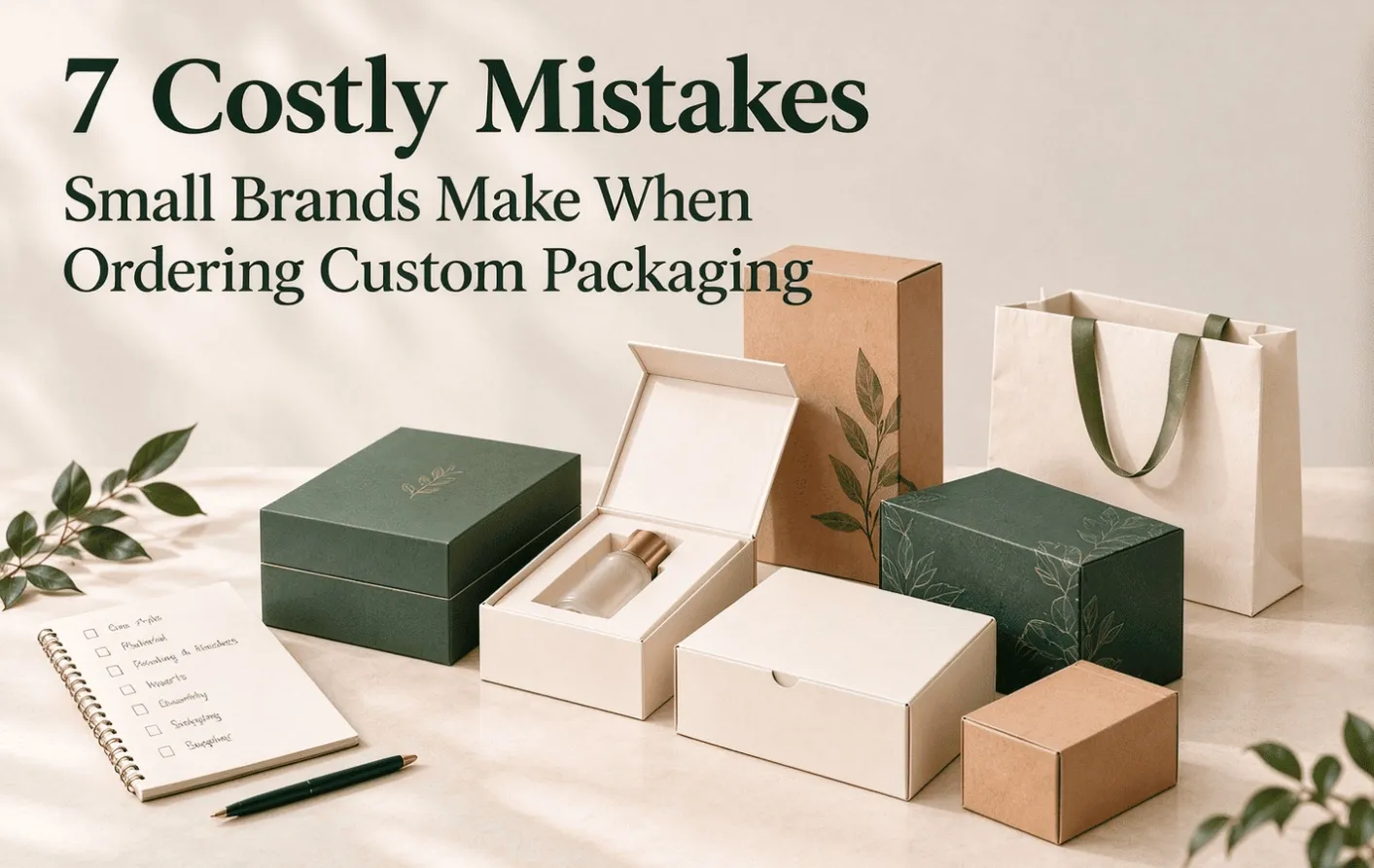
7 Costly Mistakes Small Brands Make When Ordering Custom Packaging
Ordering custom packaging for the first time can be more complicated than it looks.
A box may seem simple, but its structure, dimensions, material, printing, inserts, order quantity, and shipping method all affect its cost and performance.
For small brands, even a seemingly minor packaging mistake can become expensive. An incorrectly sized box may waste material and shipping space. An unsuitable insert may allow products to move during transit. A poorly planned order quantity can tie up cash in packaging that is no longer needed.
The good news is that many of these problems can be prevented before production begins.
Here are seven common mistakes small brands should avoid when ordering custom packaging—and how to make better purchasing decisions.
1. Choosing the Box Style Before Understanding the Product
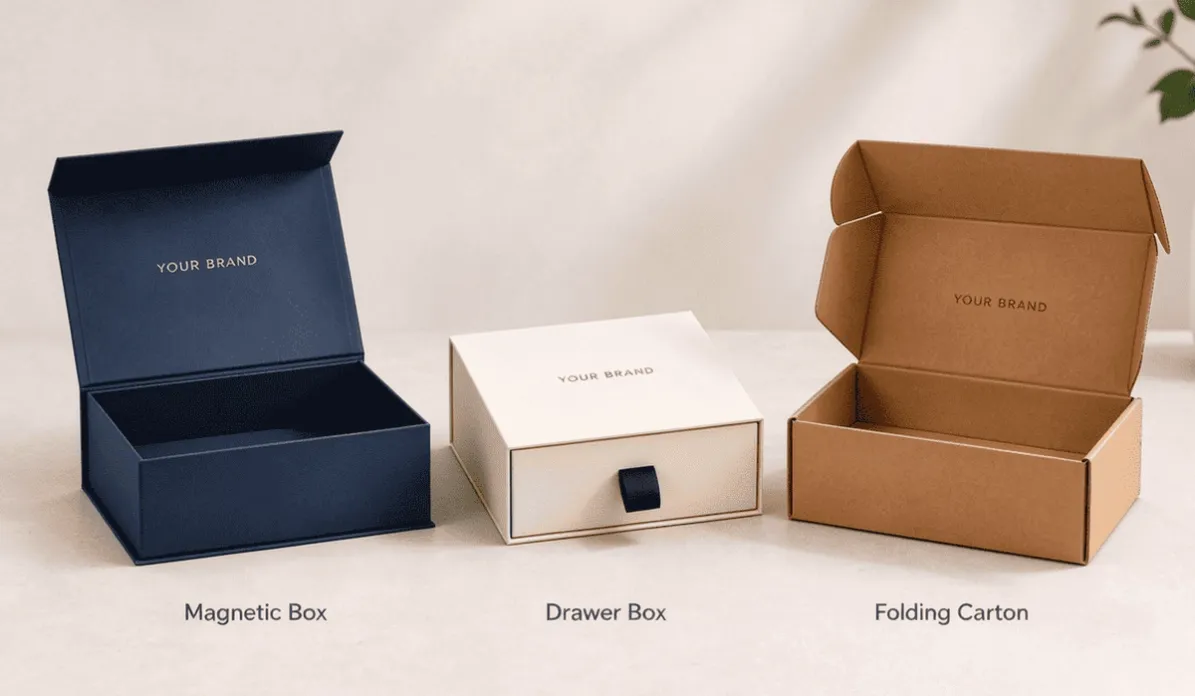
One of the most common mistakes is choosing a box based primarily on appearance.
A brand may decide it wants a magnetic closure box, drawer box, or folding carton before considering how the product needs to fit, how much protection it requires, and how the packaging will be transported.
However, the right packaging structure should start with the product, not the appearance of the box.
Before selecting a box style, consider:
- Product dimensions: Length, width, height, and any protruding parts.
- Product weight: Whether the box needs additional structural strength.
- Product shape: Whether a standard box can hold the product securely.
- Fragility: Whether the product needs cushioning or a fitted insert.
- User experience: How customers will open, remove, and store the product.
- Shipping requirements: Whether the package needs to withstand stacking, handling, and transportation.
For example, a lightweight skincare product may work well in a folding carton, while a glass cosmetic bottle may require a stronger structure and a fitted insert. A premium gift set containing several products may need a rigid box with compartments to keep everything organized.
Choosing a more expensive box does not automatically mean choosing a better solution. The goal is to find a structure that balances product protection, brand presentation, usability, and budget.
How to avoid this mistake: Share your product dimensions, weight, and packaging requirements with your supplier before committing to a box style. If you have a reference sample or product drawing, provide it during the initial discussion.
2. Comparing Packaging Suppliers Only by Unit Price
When comparing packaging quotations, it is tempting to choose the supplier offering the lowest price per box.
However, a lower unit price does not necessarily mean a lower total packaging cost.
Two quotations for what appears to be the same box may differ in important ways, including:
- Paperboard type and thickness
- Box dimensions and construction
- Printing coverage and color requirements
- Special finishes such as foil stamping or spot UV
- Custom inserts and assembly
- Tooling and sampling fees
- Master carton dimensions and packing quantity
- International shipping and delivery terms
For example, one supplier may offer a slightly lower price per box but pack fewer units into each master carton. If the shipment requires more cartons or occupies more space, the freight savings may disappear.
Another supplier may quote a lower price by using a different material or omitting a finishing process that you expected to be included.
These differences are not always obvious when you compare only the headline prices.
What should you compare instead?
Cost item | What to confirm |
|---|---|
Box specifications | Same dimensions, structure, and material |
Printing and finishing | Same colors, coverage, and special effects |
Inserts | Same material, design, and quantity |
Setup fees | Whether tooling and sampling are included |
Packing configuration | Same units per master carton, where practical |
Shipping | Same destination, shipping method, and agreed delivery terms |
How to avoid this mistake: Request an itemized quotation and compare suppliers using equivalent specifications. Evaluate the expected total landed cost, not just the unit price.
A good packaging supplier should also help you identify practical ways to optimize materials, box dimensions, packing configurations, and shipping costs.
3. Ordering Too Many Boxes Too Early
Larger orders often offer lower unit prices because setup and production costs can be spread across more units. However, ordering too much packaging before your product and sales demand are established can create a different financial problem: excess inventory.
For small brands, packaging decisions should account for more than unit price.
Consider the following before deciding on an order quantity:
- Current sales volume and realistic sales forecasts
- Available cash flow
- Storage capacity
- Product shelf life, where applicable
- Potential artwork or branding changes
- New product versions or packaging redesigns
- The cost of repeat production and shipping
Imagine that you are launching a new skincare product. Ordering a large quantity of printed boxes may reduce the price per unit, but if you later change the product name, ingredients, bottle size, or brand design, the remaining boxes may become unusable.
On the other hand, ordering too few boxes may result in higher unit costs, repeated setup fees, and additional shipping expenses.
The right quantity depends on the balance between unit savings and inventory risk.
How to choose a more suitable quantity
Ask your supplier to quote several quantities—for example, 1,000, 3,000, and 5,000 units—if those quantities are practical for the project.
Then compare:
- The reduction in unit price.
- The additional upfront investment.
- The amount of inventory you can realistically use.
- The potential cost of a future packaging change.
How to avoid this mistake: Plan packaging purchases around realistic demand rather than choosing the largest quantity simply to obtain the lowest quoted price.
4. Underestimating the Importance of Packaging Inserts
A well-designed box may look impressive, but it will not perform as intended if the product moves around inside it.
Packaging inserts can help hold products in position, separate multiple items, reduce movement, and improve presentation. They are particularly important for glass bottles, jars, delicate products, and multi-item gift sets.
Common insert materials include:
- Paperboard: Suitable for many lightweight products and branded packaging.
- Corrugated board: Useful when additional cushioning or structural support is required.
- Molded pulp: An option for shaped protection and paper-based packaging solutions.
- Plastic trays: Useful when precise cavities or specific product-retention features are needed.
- EVA or other foam materials: Often used when cushioning and a close-fitting presentation are important.
The most suitable material depends on product weight, shape, fragility, appearance, order quantity, and budget.
For example, a glass cosmetic bottle may need a fitted insert to prevent excessive movement. A box containing ten small products may require a divider or multi-cavity insert to keep every item in the correct position.
Simply making the insert opening larger or smaller without testing the actual product can create problems. A loose fit may allow movement, while an excessively tight fit can make product insertion difficult or damage the packaging.
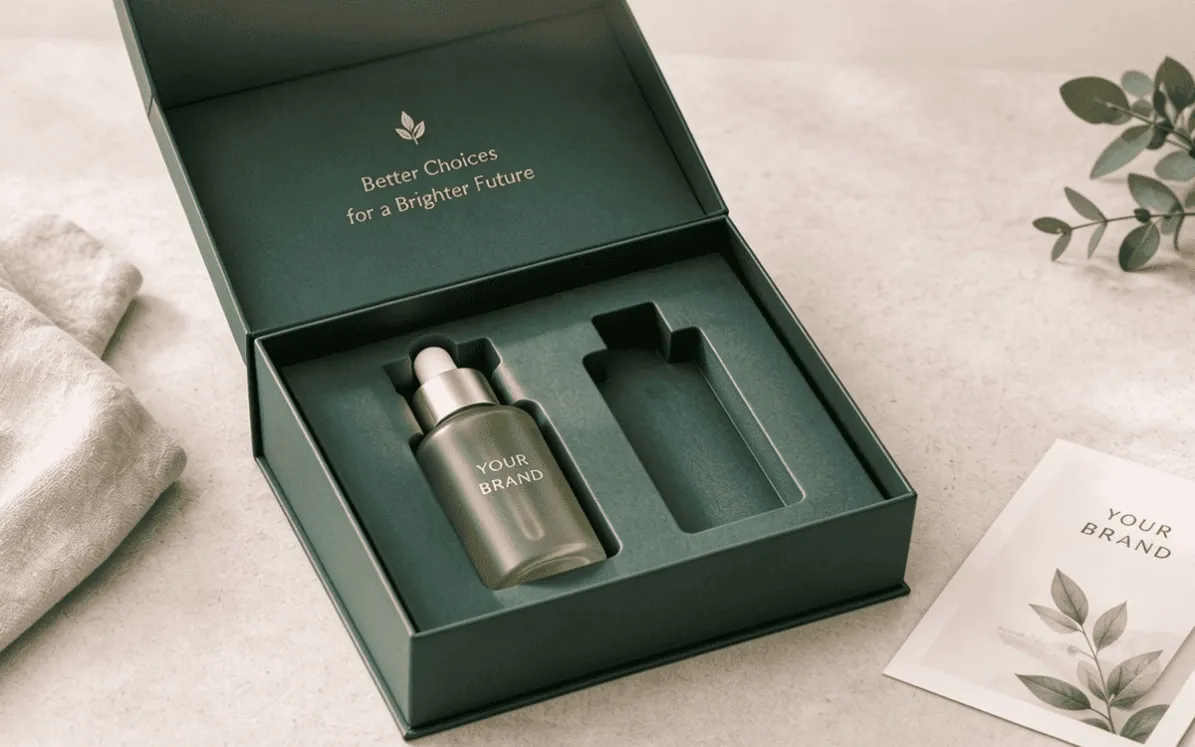
Test the complete packaging system
Before mass production, check:
- Whether the product fits comfortably.
- Whether it remains in position when the package is handled.
- Whether the insert fits correctly inside the outer box.
- Whether the product can be removed without difficulty.
- Whether the assembled package is suitable for its intended shipping conditions.
How to avoid this mistake: Treat the insert as part of the packaging structure, not an optional accessory to be decided at the last minute. Whenever possible, test the actual product with the assembled packaging sample.
5. Adding Too Many Premium Finishes
Foil stamping, embossing, debossing, spot UV, raised spot UV, and specialty papers can help packaging stand out. But using too many finishes at once can increase production costs without necessarily improving the overall design.
Each finishing process has its own material, setup, and production considerations. Certain combinations may also require additional coordination during artwork preparation and production.
Instead of adding every available effect, identify the elements that matter most to your brand.
For example:
- Logo: Gold or silver foil stamping for a metallic accent.
- Product name: Embossing or debossing for tactile detail.
- Selected graphics: Spot UV to create a contrast between glossy and matte surfaces.
- Main surface: Matte lamination for a restrained, contemporary appearance.
A package with two carefully selected finishes can look more sophisticated than one covered in multiple competing effects.
It is also important to consider how finishes interact with the material and the box structure. Certain effects may require adjustments to the artwork or additional testing, especially around folds and edges.
How to avoid this mistake: Prioritize the most important visual effect, ask your supplier about its production implications, and review a physical sample before approving the final specification.
For more details, see our guide to Packaging Finishes: A Complete Guide to Foil, Embossing, Spot UV & Lamination.
6. Forgetting About Shipping Before Finalizing the Box
Custom packaging must do more than look good when it leaves the production facility. It also needs to reach its destination in acceptable condition.
During storage and transportation, packaging may experience compression, impact, vibration, moisture, and repeated handling. International shipments can involve additional handling and changes in transportation conditions.
One common mistake is finalizing the individual box without considering how the finished boxes will be packed into master cartons.
For overseas orders, the following details can affect both cost and performance:
- Outer carton dimensions
- Units packed per carton
- Carton strength and closure
- Product movement inside each box
- Palletization requirements
- Shipping method and destination
- Available storage and handling conditions
For example, a folding carton that ships flat may use shipping space efficiently. An assembled rigid box usually occupies more volume, even when its weight is relatively low.
The way boxes are arranged inside master cartons also matters. An inefficient packing configuration may increase the number of cartons or the total shipment volume.
There is another important consideration: the master carton must fit the actual production boxes, not just the dimensions shown in an outdated or unverified template.
If the inner boxes, inserts, or packing arrangement change, the outer carton dimensions and packing quantity may need to be reviewed as well.
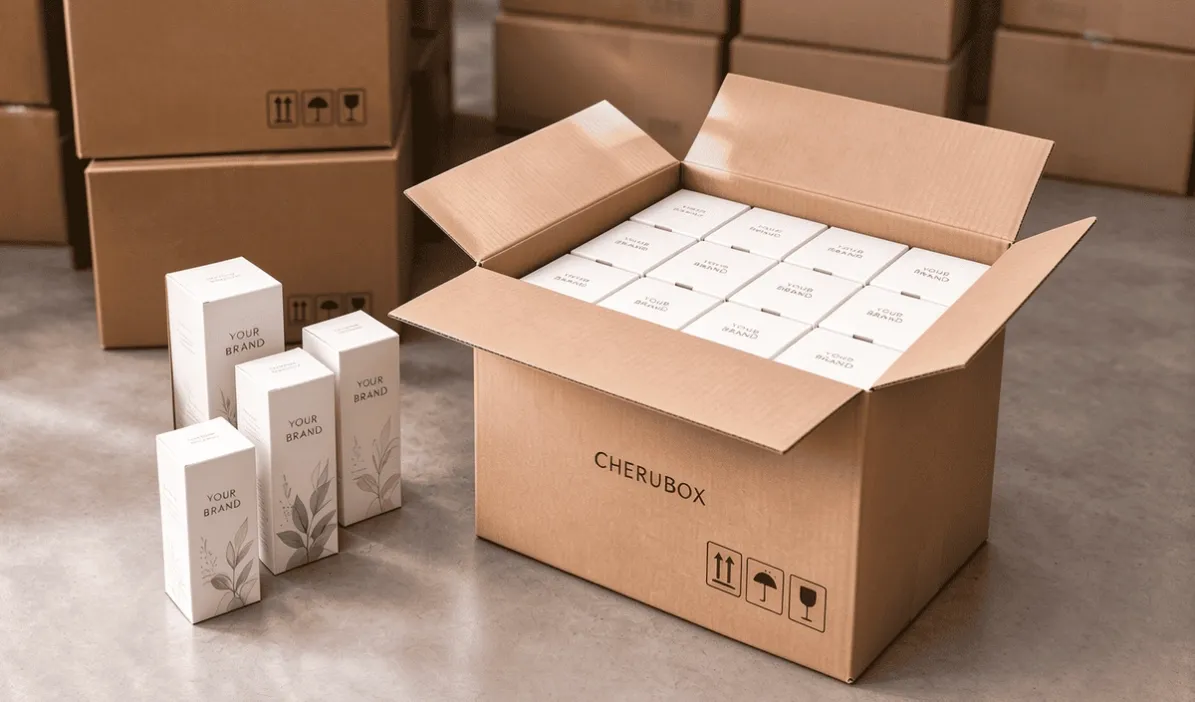
Confirm these details before shipping
Ask your supplier to verify:
- The final dimensions of the finished box.
- The number of units per master carton.
- The expected outer carton dimensions and gross weight.
- Whether the packing arrangement has been checked against the actual products.
- The shipping method and estimated freight cost.
How to avoid this mistake: Include transportation and master carton planning in the packaging discussion before production is finalized. If shipping costs are significant, ask your supplier whether a small structural or packing adjustment could improve efficiency without compromising protection.
7. Choosing a Packaging Supplier Based Only on Price
A packaging supplier should do more than manufacture boxes from an artwork file.
Especially for small brands launching a new product, the supplier's ability to identify structural issues, review materials, coordinate printing, and plan production can make a meaningful difference.
A supplier may offer an attractive price but provide limited support with product fit, sampling, quality checks, or shipping arrangements. If a problem is discovered only after mass production, correcting it may be much more expensive than resolving it during development.
When evaluating a supplier, consider whether they can help with:
- Box structure and material selection
- Product dimensions and fit
- Insert design and compatibility
- Artwork and dieline review
- Printing and finishing requirements
- Prototype and pre-production samples
- Production quality checks
- Master carton planning
- International shipping coordination
- Cost optimization and repeat orders
You should also clarify how samples are approved, how specifications are confirmed, and how any production issues will be handled.
The right supplier is not necessarily the one with the highest price or the longest list of services. It is the one whose capabilities, communication, quality standards, and production process match your project's requirements.
How to avoid this mistake: Ask potential suppliers how they handle sampling, quality checks, and problems discovered before or during production. Review their communication and technical understanding—not just their quotation.
Before approving mass production, use a checklist to review your sample. You can also read our guide to 7 Things to Check on a Packaging Dieline Before Production.
Final Thoughts: Plan Before You Place Your Order
Custom packaging is an investment in both your product and your brand. The objective is not simply to find the lowest price, but to develop packaging that meets your product requirements, supports your brand image, and fits your budget.
By avoiding these seven mistakes, small brands can make more informed purchasing decisions and reduce the risk of unnecessary costs, production delays, and packaging problems.
Before placing an order, review the complete packaging system—from box structure and materials to inserts, shipping, and inventory planning.
A little preparation before production can prevent much more expensive changes later.
Planning Your First Custom Packaging Project?
You don't need to have every packaging detail figured out before contacting a supplier.
Start with the basics:
- Product dimensions and weight
- Target order quantity
- Preferred packaging style or reference sample
- Printing and finishing requirements
- Product protection needs
- Shipping destination
Cherubox helps brands and wholesale buyers evaluate custom paper packaging options, including box structures, materials, printing, finishing, inserts, and international shipping considerations.
Share your requirements with our team, and we can help you review suitable options for your product and budget before production.
Email: sales@cherubox.com