Oct 22, 2026Buying Guides
Custom Folding Boxes: Complete B2B Buying Guide
Learn how to choose custom folding boxes for your brand. Compare carton styles, paperboard materials, printing finishes, costs, and supplier options.
Custom Folding Boxes: A Complete Buying Guide for B2B Packaging Buyers
Custom folding boxes are among the most versatile and cost-effective paper packaging solutions for brands, wholesalers, importers, and retail businesses.
From skincare cartons and cosmetic packaging to supplements, electronics accessories, and consumer products, folding carton boxes offer a practical balance of product presentation, structural functionality, customization, and shipping efficiency.
However, choosing the right folding box involves more than selecting a box style and printing your logo.
The paperboard material, box dimensions, bottom closure, printing finishes, assembly method, and order quantity can all influence the final cost and performance.
For B2B buyers, overlooking these details may lead to packaging that is difficult to assemble, does not fit the product correctly, or fails to provide the expected protection.
In this guide, Cherubox Packaging explains the most common folding box styles, materials, printing options, cost factors, and practical checks to make before placing a bulk order.
What Are Custom Folding Boxes?
Custom folding boxes, also known as custom folding carton boxes, are paperboard packaging boxes manufactured from printed, die-cut, and creased sheets.
Unlike rigid boxes, folding cartons are typically shipped flat and assembled when needed.
The manufacturing process generally includes:
- Structural design: Creating a dieline based on the required box dimensions and closure style.
- Material selection: Choosing suitable paperboard according to product weight, printing requirements, and budget.
- Printing: Applying the brand artwork using offset, digital, or other suitable printing methods.
- Surface finishing: Adding optional effects such as matte lamination, foil stamping, or spot UV.
- Die-cutting and creasing: Cutting the paperboard into the required shape and creating fold lines.
- Folding and gluing: Preparing the carton for flat shipment and later assembly.
The final assembly method depends on the box structure. Some cartons can be assembled manually, while others are designed for automated packing equipment.
Common Applications
Custom folding cartons are widely used for:
- Cosmetics and skincare products.
- Health and wellness packaging.
- Food and beverage retail packaging.
- Supplement boxes.
- Electronics accessories.
- Toys and small consumer products.
- Pharmaceutical secondary packaging.
- Retail display and promotional packaging.
For food, pharmaceutical, or other regulated applications, the material and printing specifications must meet the relevant product-contact and regulatory requirements. A standard printed folding carton should not automatically be assumed suitable for direct food or pharmaceutical contact.
1. Common Types of Custom Folding Boxes
Different folding carton structures offer different benefits in terms of assembly, appearance, closure security, and cost.
Choosing the correct structure is one of the most important decisions in a custom packaging project.
Straight Tuck End Boxes (STE)
Straight tuck end boxes have top and bottom tuck flaps that fold in the same direction.
They offer a clean appearance and are commonly used for cosmetics, skincare products, and lightweight retail items.
Best for: Lightweight products, cosmetics, skincare, and general retail packaging.
Key consideration: The closure is convenient for manual assembly, but the bottom should be evaluated carefully when packaging heavier products.
Reverse Tuck End Boxes (RTE)
Reverse tuck end boxes have top and bottom tuck flaps that fold in opposite directions.
They are a popular option for lightweight consumer products and can offer efficient paperboard utilization depending on the dieline.
Best for: Small retail products, personal care items, and lightweight accessories.
Key consideration: Reverse tuck structures are not automatically stronger or weaker than straight tuck boxes. The final performance depends on the dimensions, board, and closure design.
Auto Lock Bottom Boxes
Auto lock bottom boxes use a pre-glued bottom structure that opens into position when the carton is erected.
This can reduce manual assembly steps compared with boxes that require individual bottom flaps to be folded and tucked.
Best for: Products requiring efficient manual packing and applications where a more secure bottom is desirable.
Key consideration: The bottom design, glue quality, paperboard, and product weight must be evaluated together. Not every auto-lock structure provides the same load-bearing performance.
Crash Lock Bottom Boxes
The term crash lock bottom is often used interchangeably with auto lock bottom in the packaging industry.
Some suppliers use the names to describe slightly different constructions, while others use them for the same general pre-glued automatic-bottom mechanism.
Best for: Packaging applications that benefit from quick carton erection.
Key consideration: Instead of relying on the name alone, ask your supplier to provide a structural dieline or physical sample showing exactly how the bottom locks.
Tuck Top Boxes
Tuck top boxes use a folding lid or flap that tucks into the carton body.
They can be designed with different bottom constructions, including tuck bottoms or locking bottoms.
Best for: Retail packaging, lightweight gift packaging, and small product boxes.
Key consideration: Check whether the closure provides enough retention for the product and intended handling conditions.
Sleeve Boxes
Paperboard sleeve boxes consist of a sleeve that slides over another package or product container.
They can provide additional branding without requiring a fully enclosed outer carton.
Best for: Product bundles, branded sleeves, and minimalist retail presentation.
Key consideration: The sleeve dimensions must account for the actual external dimensions of the inner packaging, paperboard thickness, and assembly tolerances.
Window Boxes
Window folding cartons include a die-cut opening that allows customers to see the product.
Some use a transparent film patch, while others use an open window.
Best for: Retail products where visibility helps customers understand the contents.
Key consideration: The window opening may reduce panel strength. Transparent film also affects material selection, production cost, and recyclability.
Gable Boxes
Gable boxes feature a built-in handle-like top structure.
They are often used for gift packaging, takeaway packaging, and promotional products.
Best for: Lightweight gift sets, promotional packaging, and suitable food-service applications.
Key consideration: Handle strength and bottom construction should be evaluated against the actual packed weight.
Display Boxes
Display cartons are designed to present products on retail counters or shelves.
Some can be converted from a shipping or storage configuration into a display format.
Best for: Countertop promotions, small packaged goods, and point-of-sale displays.
Key consideration: Display boxes may require additional reinforcement depending on the number and weight of products they hold.
2. Folding Box Types Comparison
Box Type | Typical Application | Main Advantage | Important Consideration |
|---|---|---|---|
Straight Tuck End | Cosmetics, skincare | Clean appearance, simple assembly | Closure strength |
Reverse Tuck End | Lightweight retail products | Efficient structure | Product weight and fit |
Auto Lock Bottom | Retail products requiring quick assembly | Pre-glued bottom, faster erection | Bottom strength and glue quality |
Crash Lock Bottom | Quick-assembly packaging | Convenient automatic-bottom construction | Confirm actual dieline |
Tuck Top | Retail and gift packaging | Convenient opening | Closure retention |
Sleeve Box | Product bundles, branding | Minimalist presentation | Sliding fit |
Window Box | Retail product visibility | Shows product inside | Window strength and film |
Gable Box | Gift and takeaway packaging | Integrated carrying feature | Handle load |
Display Box | Point-of-sale promotions | Retail presentation | Product support and stability |
Buying tip: Do not select a box structure based only on appearance. Consider how the product will be inserted, whether the box will be assembled manually or automatically, and how it will be handled after packing.
3. How to Choose the Right Paperboard Material
Paperboard selection affects the box's stiffness, print quality, folding performance, and overall appearance.
Common materials include the following.
SBS (Solid Bleached Sulfate)
SBS is a premium-grade paperboard made primarily from bleached virgin fibers.
It typically offers a smooth, white printing surface and is widely used for high-quality retail packaging.
Common applications: Cosmetics, skincare, healthcare products, and premium retail cartons.
Advantages:
- Smooth printing surface.
- High-quality color reproduction.
- Clean white appearance.
- Suitable for many decorative finishes.
Considerations: Material cost and availability vary by grade, supplier, and region.
FBB (Folding Box Board)
FBB is a multilayer paperboard commonly used for folding cartons.
It often combines good stiffness with relatively efficient material weight.
Common applications: Consumer goods, food-related secondary packaging, personal care, and retail products.
Advantages:
- Good stiffness-to-weight characteristics.
- Suitable printing performance.
- Broad range of packaging applications.
Considerations: The exact composition and performance vary by board grade.
CCNB (Clay Coated News Back)
CCNB generally features a coated printing surface with a recycled-fiber backing.
It is often considered for cost-sensitive retail packaging.
Common applications: Toys, household goods, and general retail products.
Advantages:
- Can be cost-effective.
- Suitable for many standard printed cartons.
- Available with recycled-fiber content.
Considerations: Backside appearance, stiffness, odor, and suitability for specific applications should be checked.
Kraft Paperboard
Kraft paperboard is popular for brands seeking a natural, understated packaging appearance.
Its brown surface can support minimalist designs and selected printing techniques.
Common applications: Natural-style cosmetics, gifts, lifestyle products, and retail packaging.
Advantages:
- Natural paper appearance.
- Suitable for simple branding.
- Available in various grades.
Considerations: Colors may print differently on brown kraft than on white coated paperboard. White ink or additional print preparation may be necessary for certain designs.
Micro-Flute Corrugated Board
Micro-flute corrugated board includes a fluted layer that provides additional structural characteristics compared with typical single-layer folding carton board.
Common applications: Heavier products, protective retail packaging, and certain display packaging applications.
Advantages:
- Additional cushioning and rigidity.
- Suitable for selected heavier products.
- Can be combined with printable outer liners.
Considerations: Corrugated construction affects thickness, folding behavior, printing methods, and structural design.
4. What Paper Thickness Should You Choose?
Paperboard thickness is one of the most common questions from B2B packaging buyers.
For many retail folding cartons, buyers may encounter specifications such as:
- 250gsm paperboard.
- 300gsm paperboard.
- 350gsm paperboard.
- 400gsm paperboard.
However, GSM measures paper weight per square meter, not actual thickness or stiffness.
Two paperboards with the same GSM may feel different because of their fiber composition, density, coating, and construction.
For example, a 350gsm single-side-coated paperboard may feel stiffer than a different 350gsm double-side-coated grade.
This does not mean single-side-coated board is always stronger. The result depends on the specific material.
Practical Material Selection Tips
Small lightweight cartons: A suitable 300gsm grade may provide enough stiffness, depending on the box dimensions and product.
Retail cartons requiring a firmer feel: A 350gsm grade may be worth evaluating.
Larger cartons or heavier contents: Higher-stiffness paperboard, reinforced structures, or corrugated materials may be needed.
Premium cosmetic packaging: Surface quality, stiffness, and finishing compatibility should be considered together.
The most reliable approach is to review the actual product weight, box dimensions, and physical paperboard sample.
5. How to Choose the Correct Folding Box Size
The correct folding carton dimensions should provide enough room for the product while avoiding unnecessary empty space.
An oversized box may increase material consumption and create unwanted product movement.
An undersized box may make packing difficult or damage the product.
Internal Dimensions vs. External Dimensions
Packaging suppliers often use length × width × height (L × W × H) when specifying box dimensions.
However, buyers should confirm whether the dimensions refer to the inside or outside of the finished box.
This distinction is important because paperboard thickness, folds, glue seams, and structural features affect the available internal space.
What Should You Measure?
Before finalizing the box size, measure:
- The actual product dimensions.
- Any labels, caps, closures, or protruding parts.
- The required insert or protective material.
- The desired product orientation.
- The space needed for convenient insertion and removal.
There is no universal clearance allowance that works for every folding carton.
The appropriate fit depends on the product shape, material, structure, and packing method.
Practical tip: Test the product inside a physical sample before approving mass production.
6. Printing and Finishing Options for Custom Folding Boxes
Printing and finishing help turn a functional folding carton into a branded retail package.
Common Printing Methods
Offset printing
Often suitable for medium- and large-volume production where consistent print quality and efficient unit costs are important.
Digital printing
Useful for certain short runs, prototypes, and applications requiring flexible artwork changes.
The most economical method depends on order quantity, box size, artwork, material, and available equipment.
Popular Packaging Finishes
Matte lamination: Creates a low-gloss, refined appearance.
Gloss lamination: Produces a shiny surface that can enhance the appearance of printed colors.
Soft-touch lamination: Adds a smooth, velvety feel.
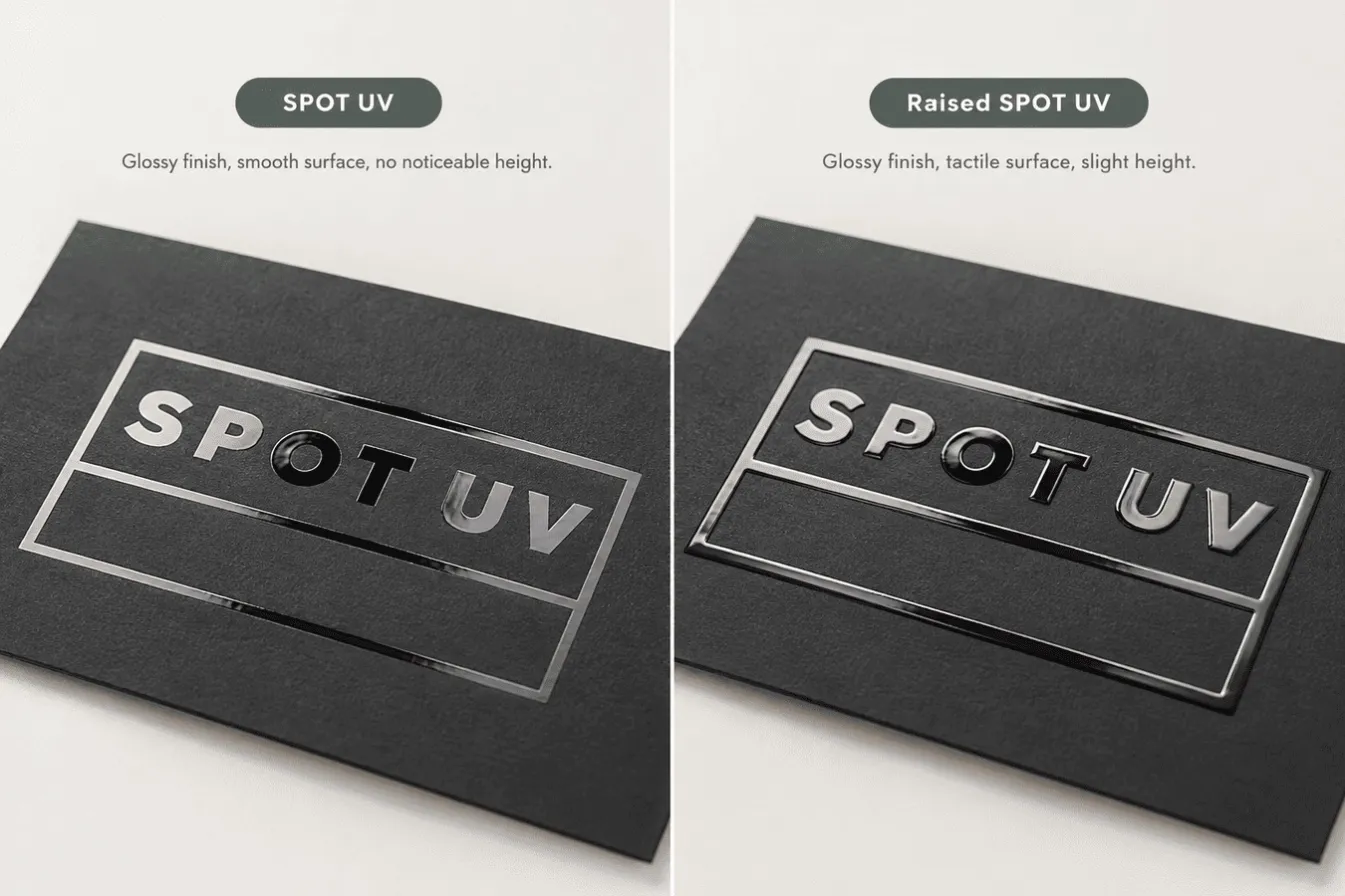
Spot UV: Applies selective gloss to logos, patterns, or other graphic details.
Raised Spot UV: Creates a more noticeable glossy, tactile effect.
Foil stamping: Adds metallic or colored foil accents.
Embossing and debossing: Create raised or recessed details in the paperboard.
Aqueous coating: Provides a coating option whose appearance and protective performance depend on the formulation.
How to Avoid Over-Finishing
Adding more finishes does not always make a folding carton look more premium.
For example, a simple matte-laminated box with selective foil stamping may create a more balanced appearance than a design combining several competing effects.
Each additional finishing process may also require separate setup, artwork preparation, or production steps.
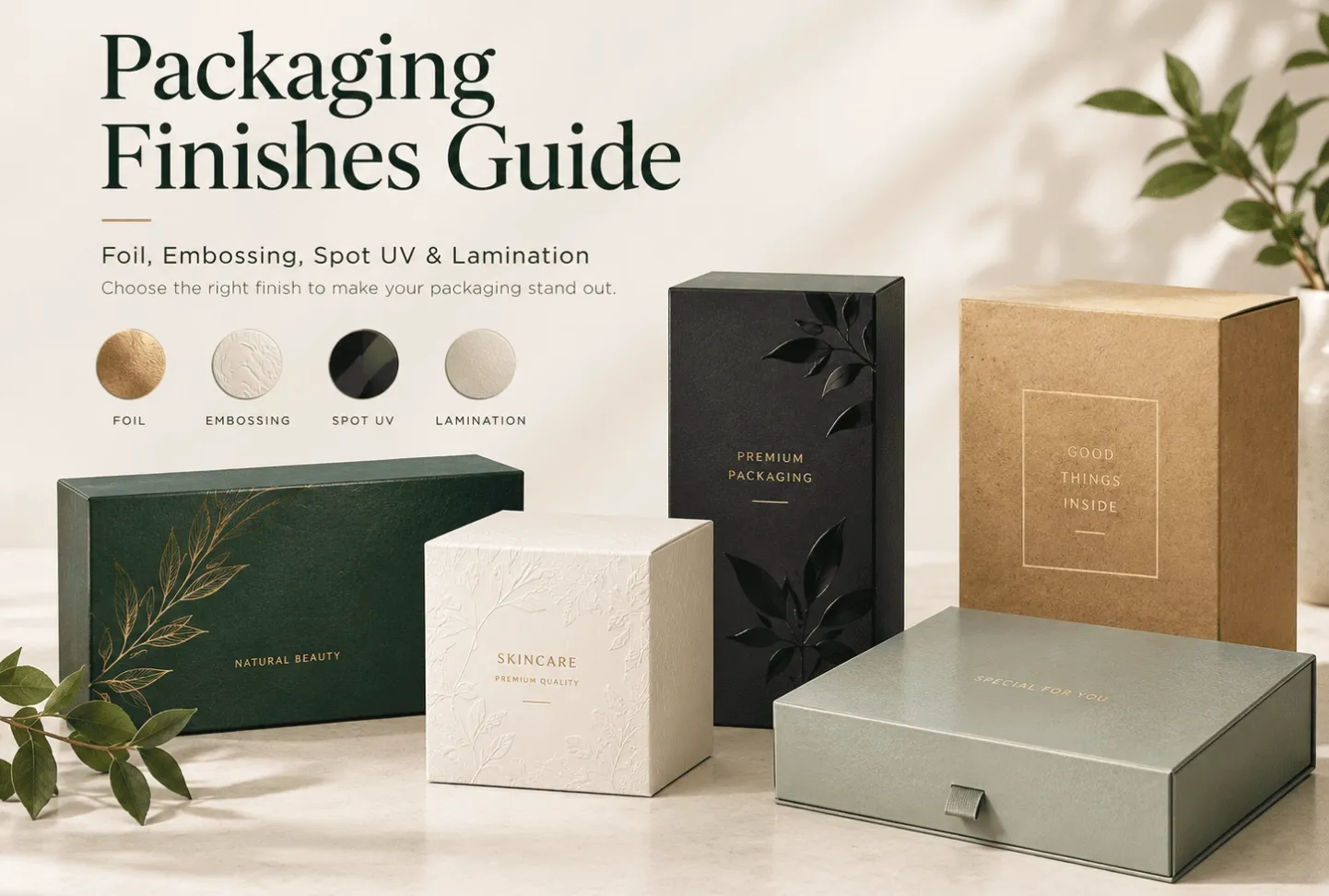
For a detailed comparison, read our Packaging Finishes Guide: Foil, Embossing, Spot UV & Lamination.
7. What Affects the Cost of Custom Folding Boxes?
The price of custom folding carton boxes depends on several factors.
Material Type and Grade
Different paperboard grades have different costs.
However, there is no universal price ranking that applies to SBS, FBB, CCNB, and kraft board in every market.
The actual cost depends on grade, availability, specifications, and purchase volume.
Box Dimensions
Larger boxes generally consume more material, but the relationship is not always proportional.
The dieline layout and how efficiently multiple boxes fit onto a printing sheet also affect production cost.
Printing Requirements
CMYK printing, Pantone spot colors, double-sided printing, and other special requirements can affect setup and production expenses.
For example, printing the same Pantone color on both sides may require separate setups for the two printing surfaces.
Buyers should confirm whether the quotation includes any additional spot-color setup charges.
Surface Finishing
Foil stamping, embossing, spot UV, and other finishing processes can add material, tooling, or processing costs.
The total depends on the finish type, coverage, design complexity, and quantity.
Order Quantity
Larger quantities often reduce the unit cost by spreading setup and tooling expenses across more boxes.
However, ordering more than the business needs can create inventory and storage costs.
Structural Complexity
Basic tuck-end boxes are often simpler to produce than structures requiring additional gluing, windows, special locks, or multiple components.
Shipping and Packing Requirements
Although folding cartons are usually shipped flat, the final freight cost still depends on master carton dimensions, packed weight, destination, and shipping method.
For a more detailed breakdown, see How Much Do Custom Packaging Boxes Cost? and 7 Ways to Reduce Custom Packaging Costs Without Sacrificing Quality.
8. Real-World Packaging Lesson: Why Bottom Closure Design Matters
A folding carton can look correct and still experience functional problems after the product is inserted.
In one packaging project, a small paperboard box used a self-locking bottom structure.
The box could be assembled and closed, but the bottom closure was not permanently glued shut.
This created a potential risk: when the product was inserted and the box was repeatedly shaken or subjected to downward pressure, the bottom could loosen or open.
The issue highlighted an important distinction between a box that can be assembled successfully and a box that remains securely closed under actual handling conditions.
What Could Be Done?
For the existing packaging, an additional sealing sticker or a small amount of glue was considered as a practical way to improve closure security.
For future production, a different bottom structure, such as a suitable auto-lock bottom, could be evaluated.
However, a revised bottom design should still be tested with the actual product.
The lesson for B2B buyers: Never assume that a closure is suitable simply because it is described as self-locking.
Before mass production, check the product weight, bottom construction, packing method, and expected handling conditions.
This is particularly important for products that may place concentrated pressure on the bottom panel.
9. Common Mistakes When Ordering Custom Folding Boxes
Mistake 1: Choosing Paperboard Only by GSM
A higher GSM does not automatically mean better structural performance.
Compare actual stiffness, thickness, folding behavior, and material quality.
Mistake 2: Ignoring the Bottom Closure
A tuck-end bottom may be sufficient for lightweight products but unsuitable for certain heavier or demanding applications.
Confirm the bottom structure through physical testing.
Mistake 3: Using Incorrect Box Dimensions
A small dimensional error can make product insertion difficult or create an unstable fit.
Always confirm the internal dimensions and test the assembled box.
Mistake 4: Overlooking the Packing Process
Manual assembly and automated packing equipment may require different structural features.
Confirm the intended packing process before approving the dieline.
Mistake 5: Adding Too Many Finishing Processes
Multiple finishing effects can increase costs and production complexity without necessarily improving the design.
Choose finishes based on the brand identity and intended visual effect.
Mistake 6: Skipping the Physical Sample
A digital mockup cannot fully demonstrate material stiffness, bottom closure performance, product fit, or surface texture.
Physical samples are especially valuable for new structures.
Mistake 7: Ignoring Export Packing Requirements
Even when folding cartons are shipped flat, unsuitable master cartons or packing arrangements may cause crushing, deformation, or surface damage.
Review the export packing method before shipment.
10. What Information Do You Need for a Folding Box Quotation?
Providing complete specifications helps suppliers prepare more accurate quotations and reduces unnecessary revisions.
Before requesting a quote, prepare the following information:
- Box style: Straight tuck end, reverse tuck end, auto-lock bottom, sleeve, window box, or another structure.
- Dimensions: Length × width × height, specifying internal or external measurements.
- Product information: Product type, dimensions, and weight.
- Material: Preferred paperboard grade or GSM, if known.
- Printing: CMYK, Pantone colors, single-sided or double-sided printing.
- Finishes: Matte or gloss lamination, spot UV, foil stamping, embossing, or other requirements.
- Quantity: Required order quantity and number of designs.
- Special features: Windows, inserts, locking mechanisms, or other structural requirements.
- Packing method: Manual assembly or automated packing.
- Shipping destination: Country, city, and delivery requirements.
If you do not have a finished dieline, you can provide product measurements, reference photos, and structural requirements for review.
A packaging supplier can then evaluate whether a suitable dieline can be developed for the project.
11. How to Evaluate a Custom Folding Box Supplier
Choosing a supplier involves more than comparing unit prices.
For international B2B buyers, supplier coordination and quality review can have a significant impact on the final result.
Consider asking the following questions.
Can the Supplier Review the Box Structure?
A reliable supplier should be able to discuss the suitability of the selected box style for the product weight, dimensions, and packing requirements.
Can They Explain Material Differences?
The supplier should help you compare paperboard options based on stiffness, appearance, printing requirements, and cost.
Will They Confirm Artwork and Dieline Requirements?
Artwork preparation, dieline accuracy, spot-color specifications, and finishing separations should be checked before production.
Can They Provide Samples?
Samples help buyers evaluate structure, fit, materials, and finishing effects before committing to a bulk order.
How Are Quality and Shipping Coordinated?
Ask how finished boxes are inspected, packed, and prepared for international delivery.
For more supplier evaluation questions, read 8 Questions to Ask a Custom Packaging Supplier Before Ordering.
Frequently Asked Questions About Custom Folding Boxes
What is the difference between folding cartons and rigid boxes?
Folding cartons are generally made from thinner paperboard and are commonly shipped flat.
Rigid boxes typically use thicker chipboard or greyboard wrapped with decorative paper and are usually supplied in an assembled form, unless designed as collapsible rigid boxes.
Folding cartons are often more economical for lightweight retail packaging, while rigid boxes are commonly selected for premium presentation and greater structural rigidity.
What is the best paperboard for custom folding boxes?
There is no single best material for every application.
SBS, FBB, CCNB, kraft paperboard, and other grades offer different combinations of printing quality, stiffness, appearance, and cost.
The correct choice depends on the product and packaging requirements.
Are 350gsm folding boxes stronger than 300gsm boxes?
Not necessarily.
A 350gsm paperboard may provide greater stiffness within the same material grade, but different paperboard constructions can perform differently.
Physical samples and material specifications provide a more reliable comparison.
Are auto-lock bottom boxes stronger than tuck-end boxes?
Auto-lock bottom boxes can provide improved bottom support and faster assembly in suitable applications.
However, their actual performance depends on the design, material, glue, and product weight.
A physical load and handling test is recommended.
Can custom folding boxes be shipped flat?
Yes. Most folding cartons are designed to be shipped flat, which can reduce storage volume and improve transportation efficiency.
However, the final packing volume depends on the structure and whether the cartons include pre-glued components or other features.
Are custom folding boxes recyclable?
Many paperboard folding cartons are recyclable where suitable collection and processing facilities exist.
However, recyclability depends on the material composition, coatings, lamination, window films, adhesives, and local recycling requirements.
Do not assume every finished folding carton is accepted by every recycling system.
Can folding cartons be used for e-commerce shipping?
Folding cartons can serve as primary or secondary retail packaging for e-commerce products.
However, standard folding cartons are generally not designed to replace protective shipping cartons for parcel delivery.
Additional protective packaging may be necessary.
What is the minimum order quantity for custom folding boxes?
Minimum order quantities vary by box structure, material, printing method, finishing requirements, and supplier.
A simple folding carton may have different production requirements from a box with special foil stamping, spot UV, or a custom window.
Contact your supplier with the specifications to confirm available quantity options.
Final Thoughts
Custom folding boxes offer an effective combination of branding flexibility, cost efficiency, and practical retail packaging performance.
However, the best result depends on selecting the right structure, material, dimensions, printing finishes, and packing method.
For B2B buyers, paying attention to these details before mass production can help reduce avoidable revisions, packaging failures, and unexpected costs.
Whether you are developing cosmetic packaging, supplement cartons, retail boxes, or a new branded product line, a well-planned folding carton can support both product presentation and operational efficiency.
Get a Custom Folding Box Quote From Cherubox
Cherubox Packaging helps brands, wholesalers, and importers source custom folding carton packaging tailored to their product and business requirements.
Our services include:
- Folding carton structure and material guidance.
- Custom dimensions and dieline coordination.
- Printing and surface finishing options.
- Sample development and quality review.
- Cost-conscious packaging recommendations.
- Export packing and international shipping coordination.
Share your box style, dimensions, artwork, order quantity, and delivery destination, and our team can help review your packaging requirements and prepare a quotation.