Oct 23, 2026Case studies
Folding Carton Bottom Closure Failure: A Real Case Study
Discover why a folding carton bottom opened during handling, how locking cuts affect closure security, and what buyers should check before production.
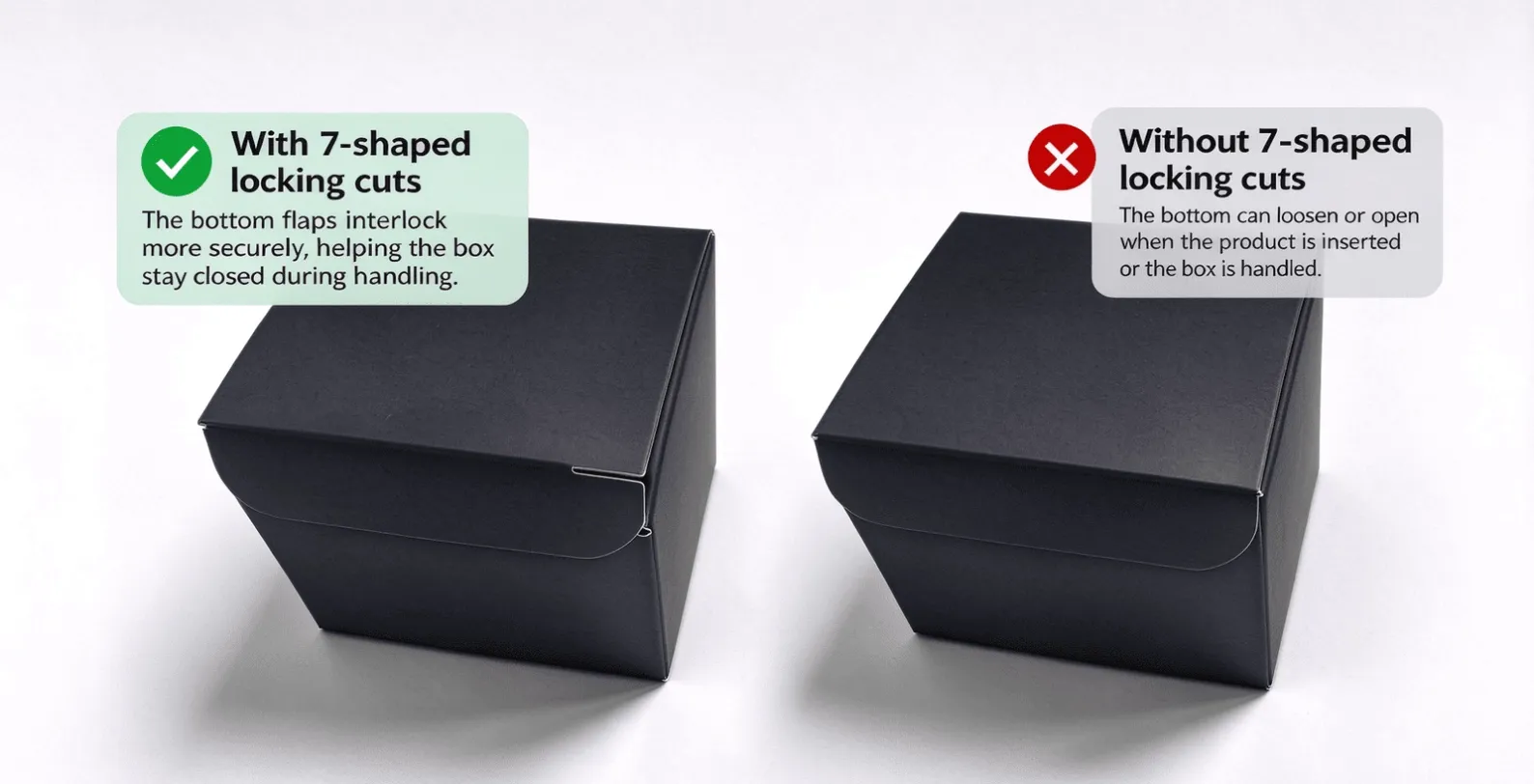
Folding Carton Bottom Closure Failure: Why 7-Shaped Locking Cuts Matter
A folding carton can look perfect, but what happens when its bottom opens after the product is inserted?
That was the challenge in a recent custom packaging project handled by Cherubox Packaging.
The customer had ordered small folding cartons using a previously approved structural template. The boxes looked correct and could be assembled normally. However, once the products were inserted, the bottom closures could loosen when the cartons were shaken or subjected to downward pressure.
The customer was understandably concerned. Similar boxes had been ordered before without the same reported problem.
After reviewing the current and previous dielines, we identified an important structural detail: the bottom design did not include 7-shaped locking cuts that could help the flaps engage more securely.
This case highlights why small locking features, paperboard stiffness, and real-world handling tests matter when developing custom folding carton packaging.
The Challenge: A Folding Carton Bottom That Wouldn't Stay Secure
The project involved several designs of small custom folding cartons for a long-term customer.
The boxes used a self-locking, tuck-style bottom rather than a permanently glued closure.
During assembly, the bottom flaps could be folded into position. But after the product was inserted, the closure did not always remain secure under movement or downward pressure.
For a retail brand, this is more than a minor structural inconvenience.
An unexpectedly opening bottom can lead to:
- Products falling out during handling.
- Additional packing work.
- Customer complaints.
- Delays in preparing finished products for sale.
- Extra costs for corrective measures.
The customer also raised an important question: Why had similar cartons appeared to work in previous orders?
Rather than assuming the latest production had introduced a new design error, we reviewed the historical packaging files.
What We Found When Reviewing the Dielines
We compared the current dieline with the structural templates used for earlier orders.
The review showed that the previous designs also lacked the small 7-shaped locking cuts that could provide additional mechanical engagement between the bottom flaps.
This was an important finding.
The locking feature had not simply been removed from the latest order. The earlier designs used a similar bottom construction.
That meant the reported closure problem could not be attributed solely to a missing feature in the new artwork.
We also needed to consider how the existing bottom structure behaved under different material and handling conditions.
Why Can Identical Dielines Perform Differently?
A dieline defines the geometry of a folding carton, but it does not determine every aspect of the finished box's performance.
Several factors can influence bottom closure security:
- Paperboard stiffness: Different paperboard grades may have different resistance to bending.
- Material thickness: Board caliper affects how folded flaps engage.
- Creasing and die-cutting tolerances: Small variations can influence flap alignment.
- Assembly consistency: The way a carton is folded can affect closure engagement.
- Product weight: Heavier contents place greater pressure on the bottom.
- Handling conditions: Repeated shaking or downward force may cause flaps to shift.
For example, two paperboards specified as 350gsm may not have identical stiffness or folding characteristics.
However, without comparative material testing, a paperboard difference should be treated as a possible contributing factor—not a confirmed cause.
The central concern was the bottom closure's ability to remain engaged under the customer's actual usage conditions.
What Are 7-Shaped Locking Cuts?
7-shaped locking cuts are small die-cut features used in certain folding carton structures to improve mechanical engagement between the bottom flaps.
Their shape resembles the number seven, creating a notch or retaining feature that helps the folded components interlock.
Depending on the carton design, these cuts may help prevent a flap from slipping out of position during handling.
<text></text>
How Do They Improve Bottom Closure Security?
In some tuck-style bottom constructions, the flaps rely largely on their folded position and friction to remain closed.
When the product applies downward pressure, the flaps may shift or gradually loosen.
Properly designed 7-shaped locking cuts can create an additional retaining point, helping the flaps stay engaged.
The effectiveness depends on:
- The position and geometry of the locking cuts.
- The shape of the interacting flaps.
- Paperboard stiffness and thickness.
- Product weight and load distribution.
- Expected handling conditions.
A small structural adjustment can improve closure retention, but it must be compatible with the complete bottom design.
Not every folding carton requires 7-shaped locking cuts. Some structures use different locking mechanisms, while others rely on pre-glued bottoms.
The important question is whether the selected closure provides adequate security for the intended product.
The Immediate Solution: Securing the Existing Boxes
By the time the issue was reported, the cartons had already been produced and delivered.
Adding new die-cut features to the completed boxes was not a practical option.
Instead of immediately recommending a full remake, we discussed corrective measures that could help the customer use the existing packaging.
Option A: Bottom Sealing Stickers
A suitable sealing sticker can provide additional retention and help prevent the bottom from opening during handling.
For the existing boxes, we offered to provide sealing stickers as a practical support option.
This approach has several potential benefits:
- No structural remake is required.
- Stickers can be applied during product packing.
- Additional closure security can be added to existing inventory.
- Implementation may be relatively straightforward.
However, the adhesive, placement, appearance, and application method should be checked before use.
Option B: A Small Amount of Glue
Another option is applying a suitable adhesive to secure the bottom flaps.
This can provide additional closure retention when properly applied.
The main considerations are adhesive compatibility, drying or curing requirements, and the extra assembly step.
Neither stickers nor glue changes the original die-cut structure. They are corrective measures for existing packaging rather than permanent structural improvements.
The Long-Term Solution: Improve the Bottom Structure
For future orders, we recommended reviewing the bottom construction rather than repeating the same design without further testing.
Several improvements could be considered.
Add Suitable 7-Shaped Locking Cuts
Where the existing flap geometry allows, properly positioned 7-shaped locking cuts may improve mechanical engagement.
The revised dieline should be evaluated to confirm that the cuts do not weaken the paperboard or interfere with assembly.
Upgrade to an Auto-Lock Bottom
An auto-lock bottom uses a pre-glued construction that opens into position when the carton is erected.
For suitable products, it may offer more consistent closure performance and faster manual assembly than a basic tuck-style bottom.
We discussed an auto-lock bottom as a possible improvement for future reorders, without an additional structural upgrade charge for that project.
However, an auto-lock bottom is not automatically the right solution for every box. Its suitability still depends on product weight, dimensions, board grade, and glue performance.
Review the Paperboard Specification
Paperboard stiffness can affect how securely bottom flaps engage.
If a material change is being considered, comparing physical samples is more useful than relying on GSM alone.
For example, a 350gsm single-side-coated paperboard may behave differently from a 350gsm double-side-coated grade.
The goal is to select a material that provides the necessary stiffness, folding performance, and print quality.
Test the Revised Structure With the Actual Product
Any structural improvement should be tested under representative handling conditions before mass production.
A box that remains closed when empty may behave differently when filled.
For this reason, we recommend evaluating the carton with the actual product, including its weight, dimensions, and normal handling requirements.
What This Case Teaches B2B Packaging Buyers
This experience offers several practical lessons for brands, wholesalers, and packaging procurement teams.
A Previously Approved Dieline Still Needs Review
Using an existing dieline can simplify repeat orders, but it does not guarantee that every future production will perform identically.
If the material, product, supplier requirements, or handling conditions change, the structure should be reviewed again.
Small Locking Features Can Make a Meaningful Difference
Structural details such as locking cuts, tabs, slots, and crease positions may appear minor compared with printing and finishing.
Yet these features can directly affect whether the packaging performs as intended.
Material Selection Affects More Than Appearance
Paperboard specifications influence stiffness, folding behavior, closure engagement, and the overall feel of the finished carton.
A material should be evaluated for structural performance as well as printing quality.
Test Packaging Under Real Handling Conditions
A visual sample approval is not enough when the packaging has a functional locking mechanism.
Buyers should check whether the box remains securely closed after the product is inserted and during representative handling.
Consider Practical Corrections Before a Full Remake
When finished packaging has a functional issue, the first step should be to evaluate available options.
For some applications, stickers or adhesive may help address existing inventory.
For future production, a structural revision may provide a more suitable long-term solution.
The right approach depends on the severity of the issue, product requirements, cost, and available time.
Folding Carton Bottom Closure Checklist
Before approving a folding carton for bulk production, confirm the following:
- Is the bottom structure suitable for the product weight?
- Do the bottom flaps engage correctly?
- Are 7-shaped locking cuts or other retaining features needed?
- Is the paperboard stiff enough for the selected closure?
- Can the box be assembled consistently?
- Does the bottom remain closed with the actual product inside?
- Has the carton been checked under representative handling conditions?
- Have all dieline revisions been confirmed before production?
- Has a physical sample been approved?
How Cherubox Supports Folding Carton Structure Optimization
At Cherubox Packaging, we help brands and wholesale buyers review packaging requirements and coordinate practical solutions for custom folding cartons.
Our services include:
Structural Review and Design Support
Reviewing dielines, bottom closures, dimensions, and assembly requirements to identify potential issues.
Material Selection Guidance
Helping buyers compare paperboard grades based on stiffness, printing performance, and product requirements.
Sample Development Coordination
Supporting sample preparation and reviewing structural details before bulk production.
Quality and Supply Chain Coordination
Communicating confirmed specifications, coordinating production requirements, and supporting quality reviews.
Practical Problem Solving
Evaluating corrective measures for existing packaging and structural improvements for future orders.
Our focus is to help customers balance packaging appearance, functionality, cost, and reliable project execution.
Frequently Asked Questions
Do all folding carton boxes need 7-shaped locking cuts?
No. The need depends on the bottom structure.
Certain tuck-style or self-locking designs may benefit from 7-shaped locking cuts, while auto-lock bottoms and other closure systems use different mechanisms.
Can 7-shaped locking cuts prevent a folding carton bottom from opening?
Properly designed locking cuts may improve bottom closure retention, but they do not guarantee that a carton will remain closed under every load or handling condition.
The structure should be tested with the actual product.
Why can the same dieline work in one order but cause problems in another?
Possible factors include paperboard properties, die-cutting tolerances, assembly differences, product loading, and handling conditions.
The actual cause should be evaluated using available samples and production specifications.
Is 350gsm paperboard better than 300gsm for bottom closure security?
Not necessarily.
Higher GSM may provide greater stiffness within the same material grade, but paperboard construction, thickness, and folding behavior also matter.
The closure design itself is equally important.
Can completed folding cartons be modified to add locking cuts?
Adding new die-cut locking features to completed bulk packaging is generally impractical.
Depending on the application, sealing stickers or suitable adhesive may be considered for existing inventory.
Structural changes are usually better implemented in a future production run.
Is an auto-lock bottom more secure than a tuck-style bottom?
A properly designed auto-lock bottom may offer improved closure retention for certain products.
However, performance depends on the complete structure, glue quality, paperboard, and product weight.
Physical testing remains important.
Final Thoughts
This case demonstrates how a small structural detail can affect the performance of an otherwise well-made folding carton.
The customer reported bottom closure problems after inserting and handling the products. Our review of the historical dielines showed that the existing structure did not include 7-shaped locking cuts that could provide additional flap retention.
For the completed boxes, sealing stickers or adhesive offered practical corrective options.
For future orders, reviewing the locking features, upgrading the bottom structure, or adjusting the paperboard specification could help improve closure performance.
The key lesson: A folding carton should not only look right and fold correctly. It must also stay securely closed under real product-handling conditions.
Need Help With a Custom Folding Carton Design?
Whether you are developing a new folding carton, reviewing a bottom closure, or preparing a repeat order, Cherubox Packaging can help evaluate your structural and material requirements.
Share your box dimensions, product weight, dieline, and order quantity. Our team can help review suitable packaging options and coordinate the next steps.