
Oct 22, 2026Case studies
How to Prevent Shipping Damage to Custom Packaging Boxes
Learn how to prevent shipping damage to custom packaging boxes with reinforced cartons, protective packing, freight comparisons, and practical B2B tips.
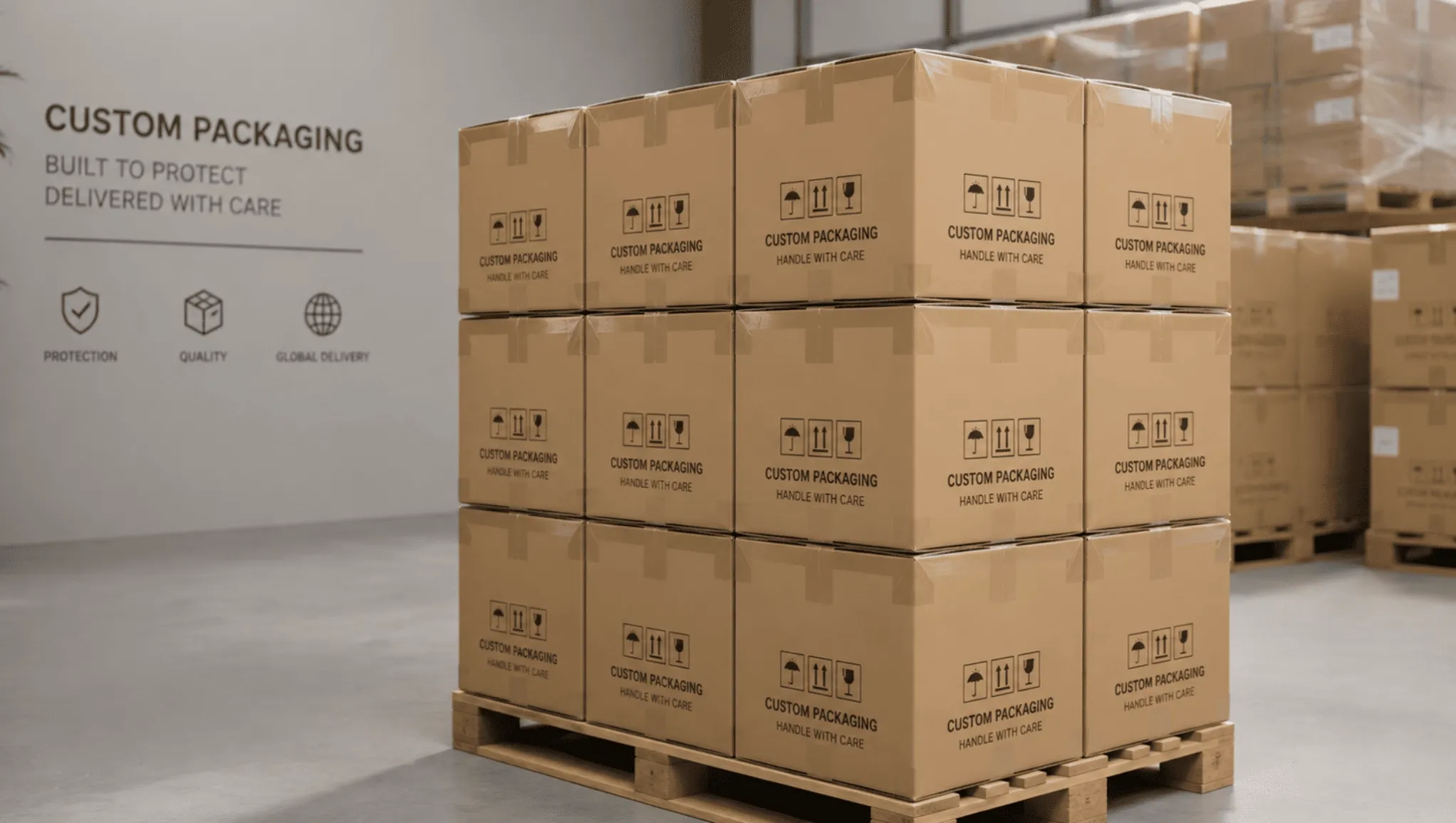
How to Prevent Shipping Damage to Custom Packaging Boxes: A Complete B2B Guide
For brands and wholesalers ordering custom packaging boxes, attractive design and high-quality printing are only part of a successful packaging project.
Your packaging must also arrive in good condition.
During international shipping, custom rigid boxes, folding cartons, luxury gift boxes, and display packaging may be exposed to stacking pressure, vibration, impacts, humidity, and repeated handling.
Even carefully manufactured boxes can arrive with crushed corners, scratches, dents, or deformation if the shipping protection is not suitable for the packaging structure and transportation conditions.
For B2B buyers, shipping damage can lead to more than replacement costs. It may disrupt inventory planning, delay product launches, and create additional logistics expenses.
This guide explains the common causes of custom packaging shipping damage, practical ways to reduce the risks, how different shipping methods affect packaging protection, and what buyers should do when damage occurs.
1. What Causes Shipping Damage to Custom Packaging Boxes?
Shipping damage can result from a combination of packaging design, export carton specifications, internal packing arrangements, and transportation conditions.
Understanding these risks is the first step toward selecting the right protection.
Rough Handling During Transportation
International shipments may pass through several handling stages, including collection, sorting, consolidation, warehouse transfers, customs clearance, and final delivery.
During these operations, cartons may experience:
- Drops or impacts during handling.
- Compression from other packages.
- Vibration during transportation.
- Abrasion caused by movement inside cartons.
- Corner impacts during loading and unloading.
For premium rigid boxes, even relatively small cosmetic defects can make the packaging unsuitable for retail presentation.
Excessive Stacking and Compression
Stacking pressure is another important risk, particularly for bulk shipments.
Corrugated shipping cartons must support the weight placed above them during storage and transportation.
If the outer carton is not strong enough, it may deform under compression.
This can transfer pressure to the custom packaging boxes inside, resulting in crushed corners, distorted panels, or damaged lids.
The risk may increase when cartons are overpacked, stacked improperly, or exposed to humid conditions that reduce corrugated board strength.
Insufficient Internal Protection
Even when the outer shipping carton remains intact, the packaging inside may still be damaged.
If there is too much empty space, individual boxes can shift during transportation.
Repeated movement can cause:
- Surface scratches.
- Corner dents.
- Friction marks.
- Damaged edges.
- Deformation of delicate packaging structures.
Proper internal packing should limit unnecessary movement without applying excessive pressure to the boxes.
Humidity and Environmental Changes
Paper-based packaging materials can be sensitive to moisture.
During long-distance transportation and storage, changes in humidity may affect the strength and dimensional stability of paperboard and corrugated materials.
High humidity can contribute to softened cartons, warping, and reduced compression resistance.
The level of risk depends on the materials, environmental exposure, shipment duration, and protective measures used.
2. Can Reinforced Export Packaging Completely Prevent Damage?
No shipping protection method can guarantee that every custom packaging box will arrive without damage.
Even reinforced cartons and cushioning materials have limitations.
A professional packaging supplier can help evaluate and improve several controllable factors:
- Export carton strength and dimensions.
- Packing quantity and arrangement.
- Internal cushioning and dividers.
- Surface protection.
- Palletizing and stacking requirements.
- Pre-shipment packing inspections.
However, carrier handling, unexpected impacts, prolonged exposure, and other transportation conditions cannot be fully controlled by the packaging supplier.
The objective is therefore to reduce the likelihood and severity of shipping damage, rather than promise zero damage.
3. Six Practical Ways to Reduce Custom Packaging Shipping Damage
The most effective protection depends on the box style, material, order quantity, shipping route, and handling requirements.
Solution 1: Use Appropriate Reinforced Export Cartons
The outer shipping carton is the first layer of protection.
For large rigid boxes, heavy packaging sets, or bulk international shipments, stronger corrugated cartons may be necessary.
Depending on the application, possible upgrades include:
- Stronger corrugated board grades.
- Double-wall corrugated cartons.
- Improved carton dimensions and packing arrangements.
- Suitable sealing tape and closure methods.
- Palletization where appropriate.
A five-layer corrugated carton may be suitable for many export applications, but the number of layers alone does not determine carton strength.
Board grade, flute structure, carton dimensions, stacking load, and environmental conditions also matter.
B2B buying tip: Ask your supplier to review the outer carton specifications based on the packed weight and transportation conditions rather than selecting carton strength only by appearance or layer count.
Solution 2: Reduce Empty Space Inside Shipping Cartons
Excessive internal space allows packaging boxes to move during transportation.
For premium packaging, repeated movement can damage surfaces and corners even when the shipping carton itself is not crushed.
Suitable void-filling materials may include:
- Kraft paper cushioning.
- Corrugated paperboard pads.
- EPE foam where additional cushioning is needed.
- Protective wrapping materials.
- Custom dividers or partitions.
The purpose is to stabilize the packed boxes while avoiding excessive pressure.
For example, if several magnetic rigid boxes are packed inside one master carton, properly sized dividers can reduce direct contact between individual boxes.
Important: More filling material does not automatically mean better protection. Overpacking can create pressure points or deform delicate packaging.
Solution 3: Protect Corners and Delicate Surfaces
Corners and edges are vulnerable to impact and compression damage.
This is especially important for luxury rigid boxes, large gift boxes, and packaging with delicate finishes.
Possible protection methods include:
- Corrugated corner protectors.
- Protective paperboard sheets.
- Soft wrapping for scratch-sensitive surfaces.
- Dividers between finished boxes.
- Additional cushioning around exposed edges.
For matte, soft-touch, foil-stamped, or other decorative finishes, surface protection may be just as important as structural protection.
The best approach should consider both the box construction and the finishing materials.
Solution 4: Optimize Master Carton Dimensions and Packing Quantity
Master carton dimensions affect shipping protection, packing efficiency, and transportation costs.
A carton that is too large may allow excessive internal movement.
A carton that is too small may compress the packaging and cause deformation.
Overly heavy cartons can also create handling difficulties.
Before production, confirm:
- How many finished boxes will be packed in each master carton?
- What is the assembled size of each box?
- Will the boxes be packed flat or fully assembled?
- Is additional space required for protective materials?
- What are the final master carton dimensions and gross weight?
These details should be considered before the freight quotation is finalized.
Accurate master carton specifications also help buyers avoid unexpected changes in shipping costs.
Solution 5: Consider Palletizing for Suitable Bulk Shipments
For larger shipments, palletizing may reduce some handling risks by allowing cartons to be moved as a consolidated load.
A suitable palletized arrangement can include:
- Stable carton stacking patterns.
- Appropriate pallet dimensions.
- Stretch wrapping.
- Corner boards where needed.
- Strapping when suitable for the load.
- Protection against overhang and uneven weight distribution.
However, palletizing is not automatically the best solution for every shipment.
Pallet dimensions, total weight, handling equipment, shipping method, and freight charges must be considered.
For small shipments, individual cartons may be more practical.
Solution 6: Review the Packing Method Before Shipment
A pre-shipment packing review can help identify avoidable problems.
For example, a packaging supplier can check whether:
- Boxes are arranged securely.
- Finished surfaces are protected.
- Cartons are sealed properly.
- Carton quantities match the packing list.
- Master carton dimensions and weights are accurate.
- The packing method is suitable for the planned shipping route.
For higher-risk shipments, buyers may also consider appropriate package testing or a trial shipment.
Relevant tests can include compression, vibration, and drop testing, depending on the shipment requirements.
Testing does not eliminate all risk, but it can help evaluate whether a packing method is suitable before a larger order is shipped.
4. Ocean Freight vs. Express Delivery: Which Is Safer for Custom Packaging?
There is no single shipping method that is always safer for every custom packaging order.
The risk depends on how the goods are packed, consolidated, handled, transported, and delivered.
Ocean Freight with Local Truck Delivery
For suitable bulk shipments, ocean freight followed by local truck delivery can be a practical option.
Potential advantages:
- May reduce individual parcel sorting when goods remain palletized.
- Suitable for larger consolidated shipments.
- Can support more controlled handling arrangements.
- May be cost-effective for bulk quantities.
Potential disadvantages:
- Longer transportation time.
- Possible exposure to humidity and stacking pressure.
- Additional handling during container loading, unloading, or consolidation.
- Pallet or truck delivery charges may apply.
This method may be worth considering for large quantities of rigid boxes, oversized gift packaging, or other bulk shipments.
However, the actual protection depends on the full transportation arrangement.
Ocean Freight with UPS or FedEx Final Delivery
Some international shipping services combine ocean freight with parcel delivery for the final stage.
This can offer flexible delivery arrangements for smaller shipments.
Potential advantages:
- Convenient delivery for smaller quantities.
- Suitable for destinations where pallet delivery is impractical.
- Flexible distribution through established parcel networks.
Potential disadvantages:
- Individual cartons may pass through additional sorting and handling stages.
- Packages may experience impacts and compression during parcel transportation.
- Reinforced packing may be necessary for delicate or high-value packaging.
For premium rigid boxes, proper internal cushioning and export carton specifications are particularly important.
Quick Shipping Comparison
Factor | Ocean + Truck Delivery | Ocean + Parcel Delivery |
|---|---|---|
Typical application | Larger bulk shipments | Small to medium shipments |
Handling pattern | May remain consolidated or palletized | Often involves individual parcel handling |
Main concerns | Stacking, moisture, consolidation and truck handling | Sorting impacts, drops and compression |
Packing priorities | Pallet stability, carton strength and moisture protection | Cushioning, corner protection and carton strength |
Cost considerations | Trucking and pallet charges | Parcel weight, dimensions and handling charges |
Key takeaway: Choose the shipping method based on the actual shipment requirements, not simply the assumption that one transportation mode always causes less damage.
5. How to Balance Shipping Protection and Packaging Costs
Adding stronger cartons, cushioning materials, or pallets may increase the packaging and freight cost.
However, insufficient protection can create additional expenses through damaged inventory, replacement production, claims, and urgent reshipments.
The goal is to balance the total landed cost with an acceptable level of shipping risk.
Standard Export Protection
Suitable for relatively durable packaging and lower-risk shipment arrangements.
May include properly specified corrugated master cartons, suitable packing quantities, and basic internal protection.
Reinforced Export Protection
Suitable for premium rigid boxes, heavier packaging, or shipments with higher handling risks.
May include stronger cartons, additional dividers, surface protection, or cushioning materials.
Enhanced Protection for High-Value Packaging
Suitable for delicate finishes, oversized packaging, or shipments where cosmetic damage would be particularly costly.
May include specialized cushioning, corner protection, palletization, or shipment-specific testing.
The appropriate level should be selected based on the actual packaging requirements rather than assuming the most expensive option is always necessary.
For additional budgeting advice, read our 7 Ways to Reduce Custom Packaging Costs Without Sacrificing Quality.
6. What Should You Do If Custom Packaging Arrives Damaged?
Even with appropriate protective packing, shipping damage can still occur.
When it does, prompt documentation is essential.
Step 1: Inspect the Shipment Upon Delivery
Check the outer cartons for visible damage, including:
- Crushed corners.
- Tears or punctures.
- Water exposure.
- Deformation.
- Broken or damaged sealing.
Where possible, photograph visible damage before opening the cartons.
If the delivery process allows it, record any visible damage on the delivery documentation.
Step 2: Document the Internal Damage
After opening the shipment, take clear photos showing:
- The outer shipping carton.
- Shipping labels and tracking information.
- The internal packing arrangement.
- Damaged packaging boxes.
- Close-up views of scratches, dents, or deformation.
Record the affected quantities and carton numbers where possible.
Step 3: Keep the Packaging Materials
Do not immediately discard damaged outer cartons, protective materials, or labels.
Carriers or insurers may require these materials during a claim investigation.
Retaining the original packaging can also help determine how the damage occurred.
Step 4: Notify the Supplier and Carrier Promptly
Contact the relevant parties as soon as damage is discovered.
Provide photographs, shipment details, affected quantities, and delivery information.
Claims deadlines vary by carrier, shipping service, contract, and type of damage.
Do not assume that all carriers use the same 24-hour claim deadline.
Check the applicable requirements and submit the claim within the specified period.
Step 5: Review the Cause Before Reordering
A damaged shipment should also be treated as an opportunity to improve the packing method.
Review whether the damage was related to:
- Insufficient carton strength.
- Excessive empty space.
- Inadequate corner protection.
- Improper stacking.
- Moisture exposure.
- Unexpected transportation impacts.
The cause may not always be identifiable, but documenting the problem can support better decisions for future orders.
7. Pre-Shipment Checklist for B2B Packaging Buyers
Before approving an international shipment of custom packaging boxes, review the following:
- Confirm the box structure, dimensions, and finished surface requirements.
- Verify the master carton specifications and packing quantity.
- Check whether internal cushioning or dividers are necessary.
- Confirm protection for corners and scratch-sensitive surfaces.
- Review carton gross weight and dimensions.
- Confirm whether palletizing is suitable.
- Check the planned shipping method and handling requirements.
- Request packing photos or videos when appropriate.
- Confirm the shipping documentation and damage-reporting procedure.
This checklist can help identify preventable risks before the goods leave the supplier.
8. How Cherubox Helps Buyers Manage Packaging Shipping Risks
At Cherubox Packaging, our role extends beyond supplying custom paper boxes.
We help brands and wholesale buyers review packaging specifications, coordinate production requirements, and evaluate practical shipping arrangements.
Depending on the project, our support may include:
Packaging Structure Review
Evaluating box dimensions, materials, assembly requirements, and potential areas of vulnerability.
Export Packing Coordination
Reviewing master carton arrangements, internal protection, and packing specifications according to the box style and shipping requirements.
Quality Inspection Support
Coordinating checks on finished packaging and reviewing packing arrangements before shipment.
Shipping Solution Planning
Helping customers compare air freight, ocean freight, and suitable final-delivery arrangements based on budget, volume, and urgency.
Cost Optimization
Considering both packaging protection costs and transportation expenses to identify practical options for each order.
For buyers managing international packaging procurement, these steps can help reduce avoidable risks and improve communication throughout the supply chain.
Frequently Asked Questions About Custom Packaging Shipping Damage
What is the best way to protect custom rigid boxes during international shipping?
A suitable combination of strong corrugated master cartons, internal cushioning, surface protection, and appropriate packing quantities is often effective.
The exact protection depends on box dimensions, weight, finish, packing arrangement, and shipping conditions.
Are five-layer corrugated cartons necessary for every shipment?
No. Five-layer cartons may be suitable for many export shipments, but carton strength should be selected according to the load and transportation requirements.
A stronger board grade or different carton design may be necessary for some shipments, while lighter-duty cartons may be adequate for others.
Is ocean freight safer than express delivery?
Not necessarily. Ocean freight and express delivery expose shipments to different handling and environmental conditions.
Palletized ocean shipments may avoid some individual parcel sorting, but they can still experience compression, humidity, and handling damage.
How can I prevent scratches on luxury packaging boxes?
Consider protective wrapping, paperboard dividers, suitable surface-contact materials, and packing arrangements that limit movement between finished boxes.
A physical packing test can help confirm whether the protection is appropriate for delicate finishes.
Can stronger shipping cartons increase freight costs?
Yes. Reinforced cartons and additional protective materials can increase gross weight or shipping dimensions.
The best solution balances added protection with the potential cost of damaged goods and replacement shipments.
What should I do if my packaging boxes arrive damaged?
Photograph the outer cartons and damaged boxes, retain the packaging materials, record affected quantities, and notify the relevant supplier or carrier promptly.
Follow the claims requirements and deadlines applicable to your shipment.
Final Thoughts
Shipping protection should be considered during custom packaging development, not only after the boxes have been manufactured.
For B2B brands and wholesalers, a well-planned shipping strategy combines appropriate export cartons, internal protection, packing efficiency, quality checks, and a suitable transportation method.
Although no solution can guarantee damage-free delivery, identifying risks early and choosing appropriate protection can help reduce avoidable losses.
The best packaging solution is one that looks professional, protects the product, and arrives in a condition suitable for its intended use.
Need Help Planning a Safer Custom Packaging Shipment?
Cherubox Packaging helps brands and wholesale buyers develop custom paper packaging solutions with attention to structure, materials, finishing, packing, and international shipping requirements.
Whether you need custom rigid boxes, folding cartons, luxury gift boxes, or display packaging, our team can help review your specifications and discuss practical protection options.
Share your box style, dimensions, quantity, destination, and shipping requirements to receive a tailored quotation.